Applied MMT Feed Items

Supreme Court Strikes Down the IEEPA Tariffs — But Markets May Be Staring at Something Worse

 â€” 

Supreme Court Strikes Down the IEEPA Tariffs — But Markets May Be Staring at Something Worse

This past Friday, we finally got the macro headline a lot of us have been waiting on: the Supreme Court ruling on the IEEPA tariffs. The decision came down early Friday morning, and the court deemed the IEEPA tariffs illegal—effectively ending the version of the tariff regime that began on “Liberation Day” last year.

If you remember the mood a year ago, we were stepping into a chaotic policy experiment: a massive wave of tariffs, a lot of uncertainty, and a market trying to price the downstream effects in real time. Now, one year later, the original structure of those tariffs has been ruled unlawful.

But here’s the catch:

The end of the EPA tariffs doesn’t necessarily mean the end of tariff-driven damage. In fact, based on what followed, we may be walking into something that’s economically worse than what we just got rid of.


The Market Reaction: Calm… Then Chaos

The immediate market response to the Supreme Court decision was surprisingly muted. Friday’s session was fairly “meh” at first—there was a modest rally into the close, but nothing that screamed regime shift.

Then the follow-on headline hit.

02/22/2026 Market Update

 â€” 

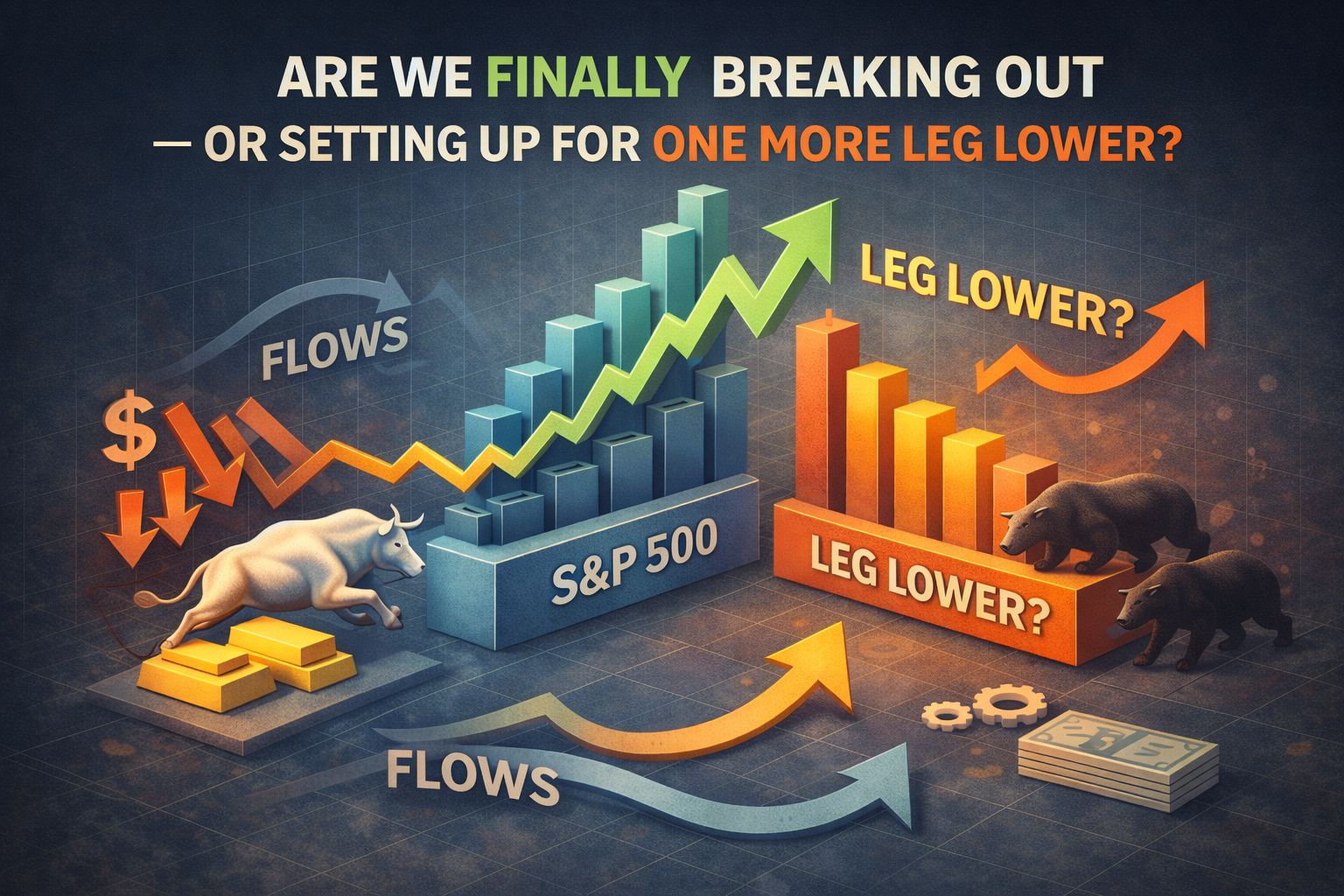
Are We Finally Breaking Out — Or Setting Up for One More Leg Lower?

 â€” 
Are We Finally Breaking Out — Or Setting Up for One More Leg Lower?

Over the past five months, the S&P 500 has gone essentially nowhere.

Yes, we’ve made marginal new highs. Yes, we’ve had bursts of volatility. But zoom out and what you see is a market stuck in sideways consolidation dating back to early October. The S&P is up barely 1–1.5% over that stretch. The Nasdaq is actually down slightly.

So the real question is:

Are we building pressure for a sustained breakout — or setting up for another leg lower first?

To answer that, we have to step away from the noise and focus on what actually drives price.

And if you’ve followed my work for any amount of time, you know exactly where this is going:

Flows.


Markets Follow Flows — Not Narratives

Heading into Q4 of last year, I laid out the case that we were likely to see volatility increase. Why?

Because underlying fiscal flows were slowing down.

That deterioration in flows — partly tied to tariff dynamics earlier in 2025 — suggested we were entering a weaker liquidity backdrop. We did get volatility, but instead of a dramatic selloff, we’ve largely just gone sideways.

That part has played out exactly as expected:

CPI Cools… But the Inflation Trade Isn’t Dead

 â€” 

CPI Cools… But the Inflation Trade Isn’t Dead

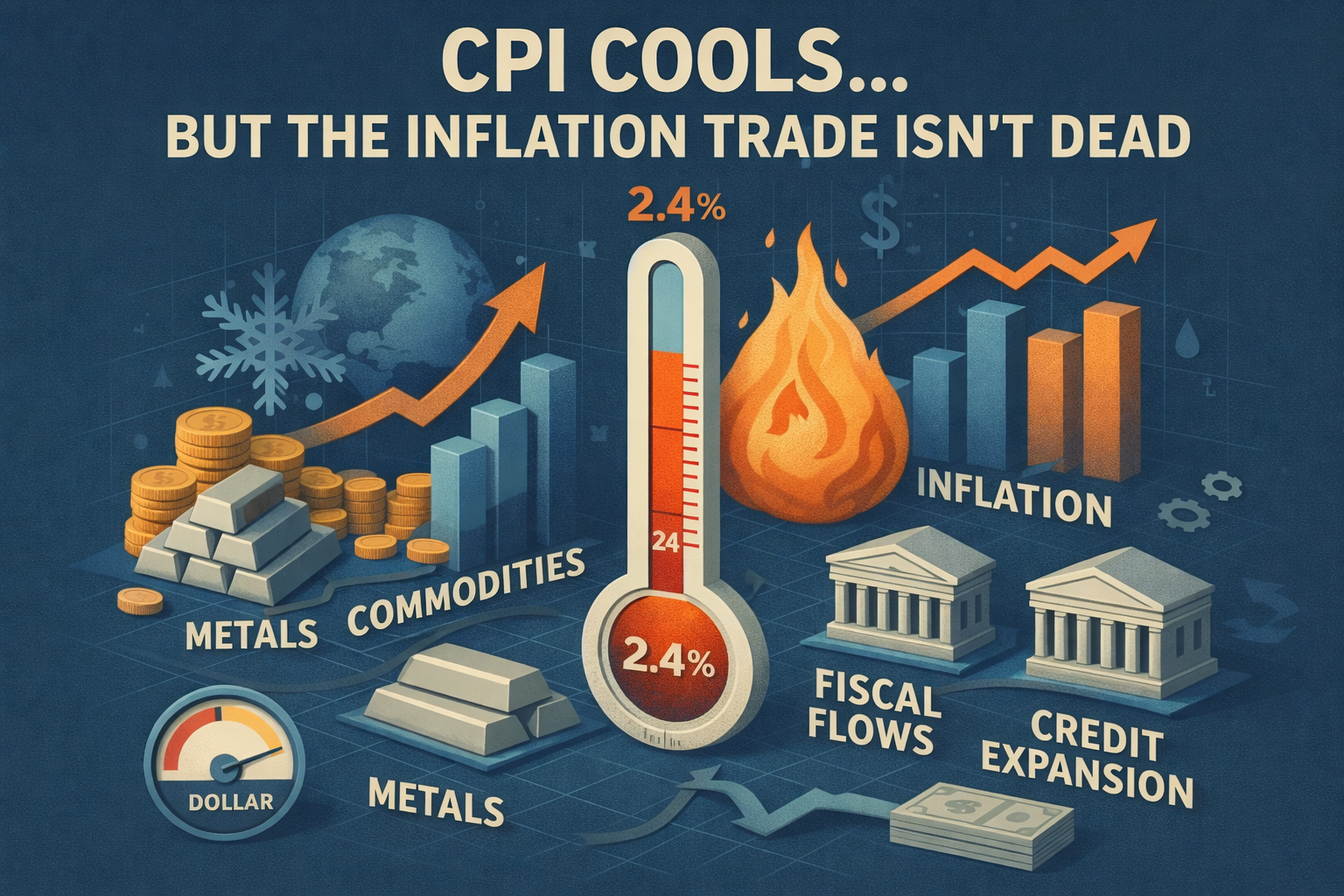
On Friday, we got the January CPI report. Headline year-over-year inflation came in at 2.4%, below the consensus expectation of 2.5%. On the surface, that looks like another step in the “inflation is cooling” narrative that has dominated over the past year.

But I want to explain why I don’t think this print changes the bigger picture—and why, from a business cycle and MMT perspective, we may actually be getting close to the point where inflation starts to reaccelerate.

More importantly, I want to walk through what this means for portfolios and asset positioning. Because if you wait for CPI to clearly turn higher before positioning for inflation, you’re probably already too late.


The Market Isn’t Fully Buying the “Cooling Inflation” Story

Here’s something interesting: even as CPI has cooled over the last year, assets that typically outperform in inflationary environments have been winning.

Think about what’s been working:

02/13/2026 Market Update

 â€” 

02/06/2026 Market Update

 â€” 

01/29/2026 Market Update

 â€” 

01/21/2026 Market Update

 â€” 

01/08/2026 Market Update

 â€” 

12/30/2025 Market Update

 â€” 

12/17/2025 Market Update

 â€” 

12/08/2025 Market Update

 â€” 

11/29/2025 Market Update

 â€” 

11/18/2025 Market Update

 â€” 

11/12/2025 Market Update

 â€” 

11/02/2025 Market Update

 â€” 

10/23/2025 Market Update

 â€” 

10/16/2025 Market Update

 â€” 

10/08/2025 Market Update

 â€” 

Market Rally Meets Resistance: Why October Could Get Dicey

 â€” 
Market Rally Meets Resistance: Why October Could Get Dicey

Over the past six months, the S&P 500 has staged an incredible rally—one that was very much in line with what my models had projected earlier this year. Back at the start of 2025, following the tariff tantrum and the heavy selloff, we flagged the market’s move as a clear mispricing. Flows were simply too strong to justify the decline, and sure enough, the rebound has been powerful.

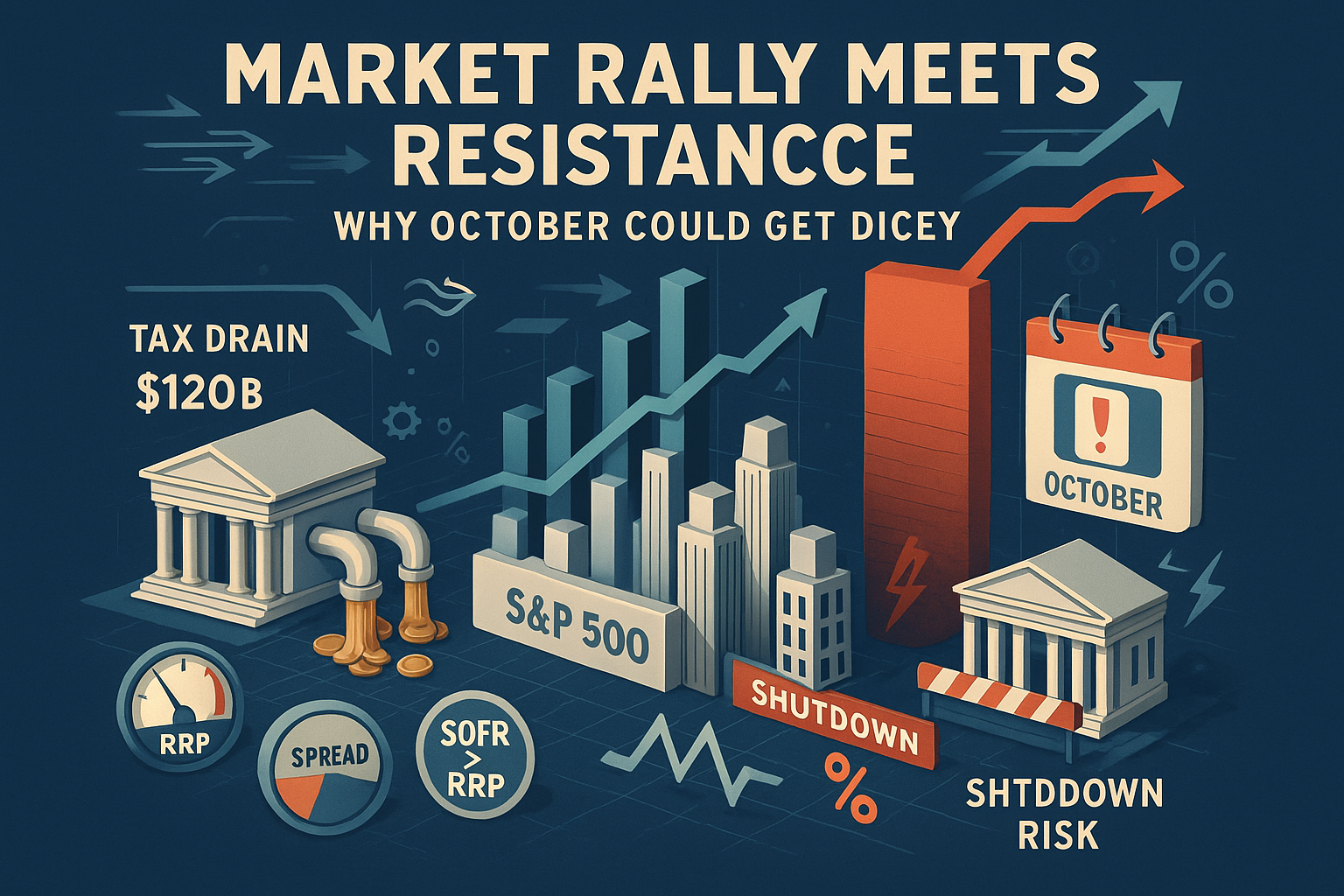
But as we head into October, the winds that fueled this rally are beginning to shift. What were tailwinds over the summer are now turning into headwinds. The key message I want to make clear is this: I believe we’re at an inflection point, and volatility is likely to spike in the near term. The rally looks exhausted, and a breather—possibly a sharp one—is overdue.

The First Domino: Treasury Flows and the Tax Drain

The most important factor right now comes down to fiscal flows. The daily Treasury statement is, in many ways, the first mover of macroeconomic outcomes.

Each September, we see a major corporate tax drain. This year, starting around September 11th, roughly $120 billion was pulled out of the private sector over a two-week period. On its own, that may not change the long-term trajectory of the economy—but in the short run, it significantly pressures the balance sheet capacity of the financial sector.

09/30/2025 Market Update

 â€” 

09/24/2025 Market Update

 â€” 

What Really Drives the Price of Bitcoin? Debunking the Liquidity Myth

 â€” 
What Really Drives the Price of Bitcoin? Debunking the Liquidity Myth

As Bitcoin continues to carve out a larger and larger share of the global financial system, the question of what truly drives its price has never been more important. For years, commentators have pointed to “Fed liquidity” as the main force behind Bitcoin’s price action. But as I argue in my latest video, this explanation doesn’t hold up under scrutiny. Instead, the evidence strongly suggests that fiscal flows—not monetary liquidity—are the true driver of Bitcoin’s long-term price trajectory.

Why “Fed Liquidity” Falls Short

In the post-COVID era, analysts have been quick to tie Bitcoin’s movements to changes in so-called Fed liquidity. Whether through quantitative easing (QE), reverse repos, the Treasury General Account (TGA), or reserve balances, the idea was that when the Fed injected liquidity, Bitcoin’s price would rise.

But there’s a fundamental flaw in this argument: Fed liquidity only swaps assets, it doesn’t add new ones. QE and related tools merely change the composition of private sector balance sheets; they don’t create new net financial assets. That means there’s no direct channel for these measures to bid up Bitcoin—or any other financial asset—in a sustainable way.

09/15/2025 Market Update

 â€” 

Jobs Data, Supply Shocks, and Where We Really Are in the Cycle

 â€” 
Jobs Data, Supply Shocks, and Where We Really Are in the Cycle

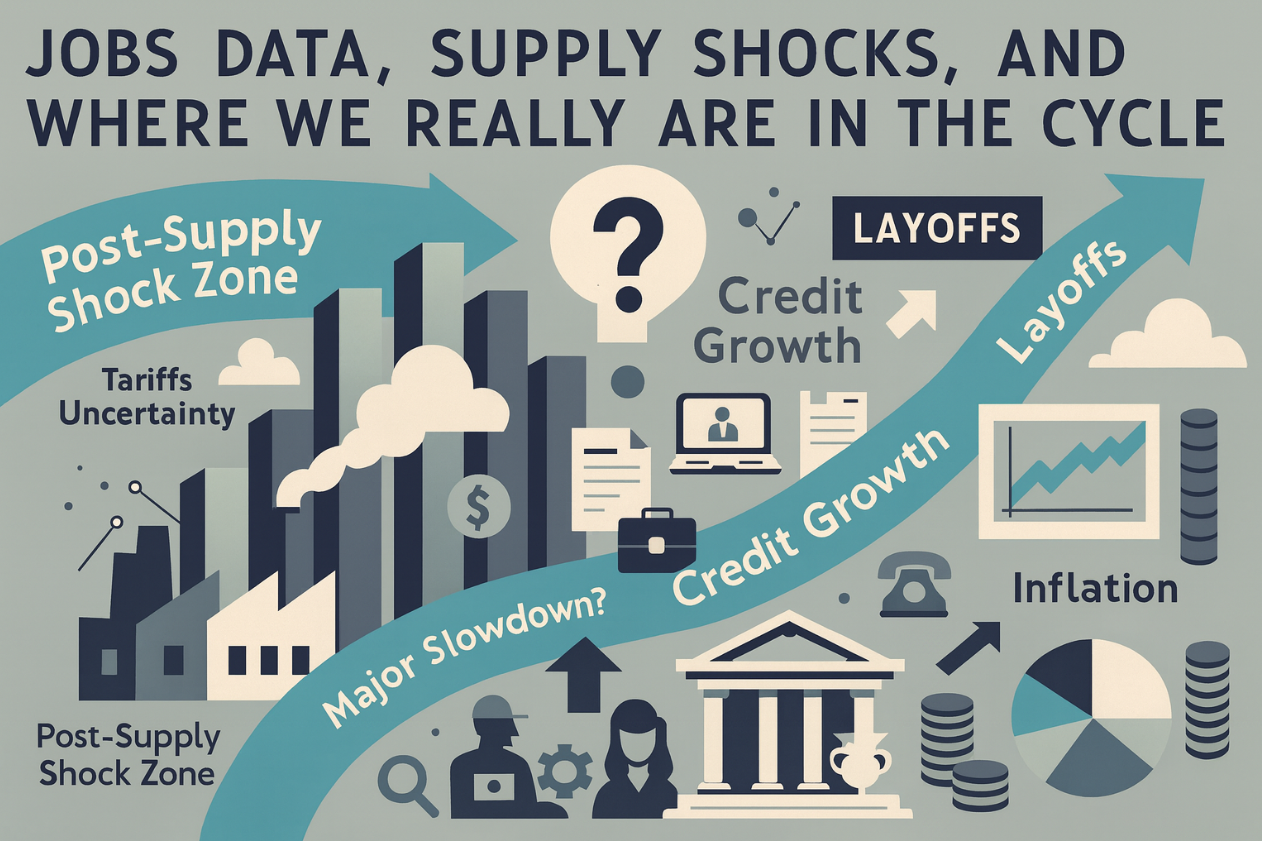
On Friday, the jobs data hit—and it wasn’t good. Non-farm payrolls came in at just 22,000, far below the already low expectation of 75,000, and well short of the 53,000 that would have at least met consensus. By any measure, that’s a weak print.

It raises a big question: are we looking at the beginning of a major slowdown, or is something else going on beneath the surface?

In this post, I want to break down how to interpret this report, why it might not mean what the “perma-bears” think it does, and how it fits into the broader macroeconomic picture.


Framing the Question: Major Slowdown or Temporary Pause?

Whenever I see a headline-grabbing data point like this, I try to step back and ask a few simple questions:

  1. What are the main drivers of the economy right now?
  2. What should we expect to see if the bearish case is real?
  3. What doesn’t line up with that story?

With jobs data, the natural concern is that weak hiring means the cycle is rolling over. But to confirm that, we need to see reinforcing signals in credit, fiscal policy, inflation, and layoffs. Without those, a bad number might just be noise—or the result of something temporary.

09/08/2025 Market Update

 â€” 

09/01/2025 Market Update

 â€” 

08/25/2025 Market Update

 â€” 

08/13/2025 Market Update

 â€” 

08/04/2025 Market Update

 â€” 

07/28/2025 Market Update

 â€” 

07/15/2025 Market Update

 â€” 

07/02/2025 Market Update

 â€” 

06/25/2025 Market Update

 â€” 

06/16/2025 Market Update

 â€” 

06/05/2025 Market Update

 â€” 

05/28/2025 Market Update

 â€” 

05/20/2025 Market Update

 â€” 

05/09/2025 Market Update

 â€” 

04/29/2025 Market Update

 â€” 

04/23/2025 Market Update

 â€” 

04/14/2025 Market Update

 â€” 

04/06/2025 Market Update

 â€” 

03/31/2025 Market Update

 â€” 

03/24/2025 Market Update

 â€” 

03/13/2025 Market Update

 â€” 

03/04/2025 Market Update

 â€” 

What’s Driving the Market Selloff? A Deep Dive into Bonds, Yields, and the Fed

 â€” 
What’s Driving the Market Selloff? A Deep Dive into Bonds, Yields, and the Fed

Markets have had a rough ride lately. Just last Wednesday, we hit fresh all-time highs, only to see a sharp selloff in the days since. As of writing this, the S&P 500 has dropped around 4.5% in just five trading days. So, what’s going on? What’s driving this pullback?

If you follow financial media, you’ll hear a common explanation: the bond market. Specifically, falling bond yields have been blamed for the market's weakness. But does that explanation really hold up? Let’s break it down and take a closer look at the broader macroeconomic forces at play.

The Bond Market’s Message—Should We Be Concerned?

A traditional macroeconomic interpretation of falling bond yields suggests that investors are flocking to safety due to concerns about future economic growth. If the market truly feared a slowdown, we’d expect capital to shift into bonds, pushing prices up and yields down. This logic, at least in theory, makes sense.

02/27/2025 Market Update

 â€” 

02/21/2025 Market Update

 â€”