A young colleague recently asked why, given the prevalence in society of gold bugs, crypto bros, and the like, the Finding the Money documentary didn't spend any time on arguing for the merits of chartalism over metallism (or some form of belief in commodity money).
Personally, I'd watch the hell out of a documentary logically working through the consequences of the currency monopolist's role as price setter, but I think I'd be in the minority there. I suspect most people would find it tiresomely arcane. In fact, allow me to demonstrate with what follows.
"The price level is necessarily a function of prices paid by the government’s agents when it spends, or collateral demanded when it lends.
"In what’s called a market economy, the government need only set only one price, as market forces continuously determine all other prices as expressions of relative value, as further influenced by institutional structure." - Warren Mosler, MMT White Paper
If, via a "gold merchant of last resort" policy, the government chooses to set the general price level by constantly outbidding the private market for a single commodity like gold (with no concurrent measures to constrain the private sector's ability to further outbid that price), you can derive Alfred Mitchell-Innes' (1913) conclusion from Warren's premises:
"The governments of the world have, in fact, conspired together to make a corner in gold and to hold it up at a prohibitive price, to the great profit of the mine owners and the loss of the rest of mankind. The result of this policy is that billions of dollars worth of gold are stored in the vaults of banks and treasuries, from the recesses of which they will never emerge, till a more rational policy is adopted.
"Limitations of space compel me to close this article here, and prevent the consideration of many interesting questions to which the credit theory of money gives rise; the most important of which, perhaps, is the intimate relation between existing currency systems and the rise of prices.
"Future ages will laugh at their forefathers of the nineteenth and twentieth centuries, who gravely bought gold to imprison in dungeons in the belief that they were thereby obeying a high economic law and increasing the wealth and prosperity of the world."
A gold (or any commodity) standard is inherently inflationary, because "Coins can only remain in circulation for any length of time if their nominal value exceeds their intrinsic value" (Mitchell-Innes, 1914). So if the government declares the nominal value of a currency unit to be precisely the intrinsic value of a given weight of gold, who will sell that gold at that price to the government (or anybody else, for that matter)? It is simply the exchange of an amount of gold for a demand deposit of the exact same amount of gold redeemable at the central bank! There is no profit to be had!
So the government has to buy at a higher price, and in doing so raises the market price. It must do this in order to have the stock on hand to meet it's (self-imposed) obligation to exchange government credit for for gold. So now the government is buying high and selling low in the gold market. Which effectively devalues the government's credit relative to gold, and for anybody in the private sector with spare cash on hand the sensible thing to do is to take advantage of the situation. If I had just sold gold to the government at a higher price than that at which they promised to sell it back, I would have a strong incentive to (at the very least) immediately buy it back, pocket the difference, and wait for the government's next inevitable purchase order.
So now for a government which wants to maintain the belief that it is gold which is bestowing value on money (rather than vice versa) there are two apparent methods to prevent the private sector rushing to the bank to exchange money for underpriced gold:
- Validate the higher market price of gold by increasing the price of redemption. However doing so puts us back in our original quandary.
- Abandon the gold standard.
Obviously if you choose option 1., it doesn't ultimately solve anything, but a government can keep choosing 1. and chasing it's own tail in an inflationary spiral until it admits defeat (option 2.).
Note also that this inflationary dynamic will be present even in the absence of a severely constrained supply of gold. Neoclassical supply/demand analysis does not apply in cases of monopoly supply. The inflation is entirely an artifact of the government failing to understand it's capacity as price setter.
A gold standard regime necessarily sets the domestic price of gold; it cannot be the value of gold which imparts value to the currency.
As Mitchell-Innes put it, "The value of credit does not depend on the existence of gold behind it, but on the solvency of the debtor", because "Government money is redeemed by taxation", not gold.
That is, the underlying asset (as finance people would say) of the public money contract is the government's ability to impose financial obligations (eg. taxes) upon the private sector. It is that which makes the government credit-worthy, in the sense that it's money is accepted by the private sector in exchange for labour, resources, or finished goods.
Additional pledges (to exchange outstanding liabilities for gold, or a foreign currency, or whatever) may be at best seen as collateral, but bear in mind that with any monopolist such terms are extended entirely at their discretion, and may be withdrawn at any time.
Given adequate supply, a currency-issuing government can however hold the price of gold (or whatever) at any level it chooses, as Mitchell-Innes (1914) understood: "The issue of coins in exchange for gold at a fixed and excessive price, without providing taxes for their redemption, causes an inflation of government money, and thus causes an excessive floating debt and a depreciation of government money." (Emphasis mine.)
A more MMT-friendly way of stating this is to say that the government is always able to create fiscal space for the transfer of resources from the private sector to the public sector at the price the government wishes to pay. This might require the imposition (or increase) of taxes — or in extreme circumstances the use of other regulatory mechanisms, for example rationing. This would have the effect of making gold less desirable than money as a savings vehicle in the private sector, in proportion to the government's desire to accumulate gold for itself. These are obviously politically unpopular measures as a rule, which is why governments tend instead to jettison gold standard regimes. However in principle, the widely presumed inflationary effect of government spending is not only exceptional but wholly optional.
For any monopolist (including the money monopolist, as Warren Mosler points out), market discipline through the effect of supply and demand does not apply.
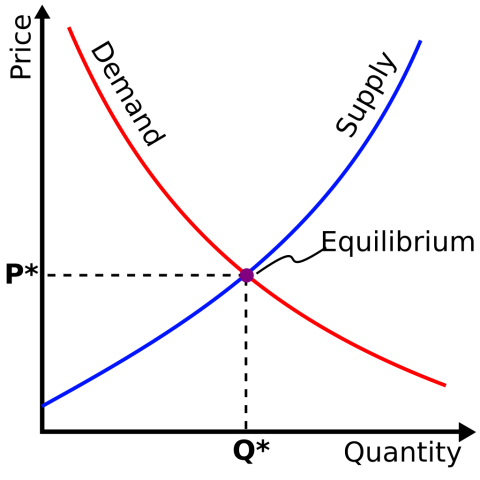
The relevant policy question in a mixed public/private economy concerns which prices ought to be deliberately set by government, and which should be allowed to be determined by the private sector. As Warren says, to set a general price level the currency issuer need only pick one price — though it could choose more — and allow other prices to float.
The recognition of this elementary fact obviously opens a huge political can of worms. Indeed I think the application of the MMT political-worm-can-opener is long overdue, and would contribute substantially to solving a lot of our most urgent political and economic problems.
However, to return to our original question, choosing to set the price of gold for no reason other than to see it accumulate in bank vaults and thereafter gather dust, is as Mitchell-Innes observed over a century ago, nothing more than a ridiculous exercise aimed at reassuring those who cling to nonsensical superstitions.
Not only the gold standard, but other superstitious nonsense, such as debt ceilings, balanced budget or "fiscal credibility" rules, "fiscal buffers" or "future funds", and so on can be seen as particular instances of a general mistaken belief that the value of money is determined by publicly guaranteed exchangeability for other commodities, and/or the maintenance of a given level of supply relative to exogenous market demand.
In reality, both money's price (in terms of what must be surrendered to obtain public money) and demand (via the imposition of taxes, etc.) are determined (by commission or omission) by the government. Whether they know it or not.