Why spend months reading Marx’s so-called ‘notebooks’ in Theories of Surplus Value, Part 1 (TSVI) when you could skip to where those notes find coherence in the polished manuscript of Capital, Volume 1 (hereafter KI)?
Dr Tobias Cremer, Member of European Parliament, joins Dr Emma Shortis to discuss how Europe is responding to the second Trump administration, the Australia-EU Free Trade Agreement, and how to build democratic solidarity in the face of rising authoritarianism.
This episode was recorded on Wednesday 14 October.
Guest: Tobias Cremer, Member of European Parliament
Host: Emma Shortis, Director, International & Security Affairs, the Australia Institute // @emmashortis
The violent attack on Helen Haines is deeply shocking and distressing and The Australia Institute joins the rest of country in sending her love and our very best wishes as she remains in critical condition.
Helen is a tireless advocate for her community, and our thoughts are with Helen, her family and her community right now.
If there is one word that sums up the experience of working with Helen Haines it is this: integrity. That Helen was the target of this allegedly deliberate violence is deeply disturbing.
The Australia Institute has had the privilege to work with Helen and her team over many years to make the case for a National Anti-Corruption Commission, and it is abundantly clear why so many in the Parliament and in the community hold her in such high regard.
Australia is a democracy in which everyone should be able to participate in public life without the threat of violence. Each one of us has a responsibility to uphold the values that Helen Haines exemplifies every day in her work, working with integrity, decency, passion for making our community better, and above all, respect for others.
I wake up early to watch the sun and the gas prices rise.
My motel faces a field of sunflowers that sprawls to a truck stop called Love’s. I heard that sunflowers lift their heads to face the sun, like Donald Trump during a solar eclipse. Will they still look up when it’s 80 degrees at dawn? I wonder what it’s like to be a flower named for what kills you when it gets too strong.
The sun blazes down on my tombstone hat. I found the hat in a gas station on a shelf of discounted “250th anniversary of the USA” merchandise. My hat is black and boasts an epitaph: “AMERICA: 1776-2026”. My hat was made in China.
Sarah Kendzior’s Newsletter is a reader-supported publication. To receive new posts and support my work, consider becoming a free or paid subscriber.
“A people that takes no pride in the noble achievements of remote ancestors will never achieve anything worthy to be remembered with pride by remote descendants.” — Thomas Babington Macaulay
What does a child need to know about the history of the Western world? The College Board claims to know the answer. Until 2019, the AP World History exam required students to master a sweep of history stretching back 10,000 years, from the first river civilizations to the present. Today, those requirements are much thinner. AP World History: Modern begins its tested content at 1200 AD. Ancient Greece and Rome—the birthplace of philosophy, republican government, Western aesthetics, and nearly everything that follows—are absent from the exam altogether. A student can earn a perfect score without ever being asked about Socrates, Augustus, or the Battle of Marathon.
This is not an isolated retreat. A 2017 report by the National Association of Scholars found that the College Board’s AP European History exam had scrubbed all mentions of religion, intellectual history outside of secular modernization, and the history of political liberty. The College Board later made very limited revisions, and the course remains a shell of what it once was.
Three in four Australians would have to cut back if their rent or mortgage rose by just $20 a week, with many having to go without food and medication, according to an Everybody’s Home survey.
The ‘No Room to Move’ report captures survey results between July and September of 1,150 people including renters, home owners, and those experiencing homelessness or living in temporary housing.
The report found one in four respondents are worried they will become homeless if rents keep rising over the coming year.
Meanwhile, more than one in three said the condition of their home has either made them or someone in their household sick because of cold or heat, mould, damp or poor ventilation.
The majority of renters have avoided asking for repairs, fearing it would result in a rent increase or being unable to find an affordable home if they were forced to move.
On this episode of What’s the Point?, Alex Fein, researcher and strategist at Redbridge, joins Richard Denniss to discuss why so many Australians are angry right now, the real message many voters are sending to the political establishment, and the dirty secret about productivity.
From a young age, we ask kids what they want to be when they grow up. Firefighter, doctor, president, mechanic, astronaut, teacher, actor—the list goes on.
Dreams shift as children discover their gifts, what they enjoy, and where the two overlap. The kid who wanted to be a doctor might change his mind after finding out he can design spaceships and likes math better than anatomy.
Allowing people to follow their dreams has always been an American aspiration and part of what makes our country exceptional. Yet today, one group of Americans—young men—is at risk of being shut out from their dreams, largely through no fault of their own.
Mountains of evidence show that our education system and economy are increasingly leaving boys and men behind. This is a national crisis our political leaders must urgently acknowledge and address.
For Exhibit A, simply look at the last 50 years of wage trends. Although earnings for women have steadily increased, nearly doubling in the last half-century, men’s wages have remained largely stagnant. Indeed, while the inflation-adjusted median full-time wage for women has grown by $21,750 since 1976, it has increased for men by only $7,570.
The Obama Presidential Center, located on Chicago’s South Side, opened in June 2026, nine years and five months after Barack Obama’s term in office concluded. The politicians who build these centers force themselves to run one final fundraising gauntlet, not to finance an election campaign but to leave behind an edifice that makes an enduring case for their probity, sagacity, and historical importance.
What sets Obama apart is that he began publicly discussing the greatness he hoped for prior to occupying, winning, or seeking the nation’s highest office. “My attitude about something like the presidency is that you don’t want to just be the president,” Barack Obama told journalist Jacob Weisberg in 2006. “You want to change the country. You want to make a unique contribution. You want to be a great president.” Later in the interview he said, “There are, what, maybe 10 presidents in our history out of 40-something who you can truly say led the country? And then there are 30 who just kind of did their best.”
Every morning, straight after Wordle, I open my media monitoring email to see where The Australia Institute has appeared across TV, radio and news sites. Yesterday morning, I checked my media monitoring to find more than 200 mentions of our work out in the world. This is on the high side of daily mention numbers but certainly not unheard of. When our research is reported that widely, it’s reaching audiences from across the political spectrum, on media from the ABC to News.com.au and commercial talk back radio.
Which begs the question – were all of the people consuming this media part of the ‘converted’? Who knows? Outside of a religious experience, I’m not even sure what constitutes converted. I bristle at the use of the saying “preaching to the converted” as a pejorative. When I’m talking to people who share my views, I find it comforting, enriching and at its best, challenging. When I trust the person I’m listening to, I’m more open to hearing points of difference. That’s a very human thing.
The Australia Institute has built trust with large swathes of the Australian public – including people who don’t agree with us, and people who open News.com.au in the morning rather than The Guardian. That trust has been earned over decades of diligence in how we conduct our research and communicate our findings. It also comes from researching issues that matter to most Australians.
Which brings me back to yesterday’s bumper media roundup.
The American Mind’s podcast is a weekly conversation with Ryan Williams, Spencer Klavan, and Mike Sabo devoted to uncovering the ideas and principles that drive American political life. Stream here or download from your favorite podcast host.
Europe Lurches Leftward Toward Disaster. Can It Recover? | The American Mind Podcast
America came closer to going net zero than many realize. To explain its rise, we need to consider a prophetic 1983 essay, “Risk and Culture,” by British anthropologist Mary Douglas and American political scientist Aaron Wildavsky. They argued that the risks a society deems most serious are a product of culture. “Each social arrangement elevates some risks to a high peak and depresses others below sight. This cultural bias is integral to social organization,” they wrote.
Douglas and Wildavsky observed the rise of the environmental movement as an insurgent political force, or what they termed the “border.” Led by white Boomer liberals inspired by the African Americans’ fight for civil rights, environmentalists appropriated the movement’s moral absolutism and refusal to compromise.
When German economist Isabella Weber spoke at Toronto Metropolitan University in May 2024, she argued that Canadians, “need an inflation fighting toolbox that buffers against supply shocks in essential sectors, prevents price explosions, and contains sellers’ inflation.” This policy prescription came after Canadians experienced the economic shocks of the COVID-19 Pandemic, with the inflation rate peaking at 8.1% in June 2022, while wages struggled to catch up.
In communities throughout the United States, the infrastructure required to surveil and track anyone is rapidly being constructed, from Automatic License Plate Reader (ALPR) systems to fusion centers to the hyperscale data centers used to store the vast amount of information being gleaned from consumer products and surveillance devices. As the public becomes more aware of the hazards of this infrastructure and the extent that the state is intruding into their lives, a broad, organic national grassroots movement has formed and has already won significant victories, which frightens the political elites and their corporate benefactors.
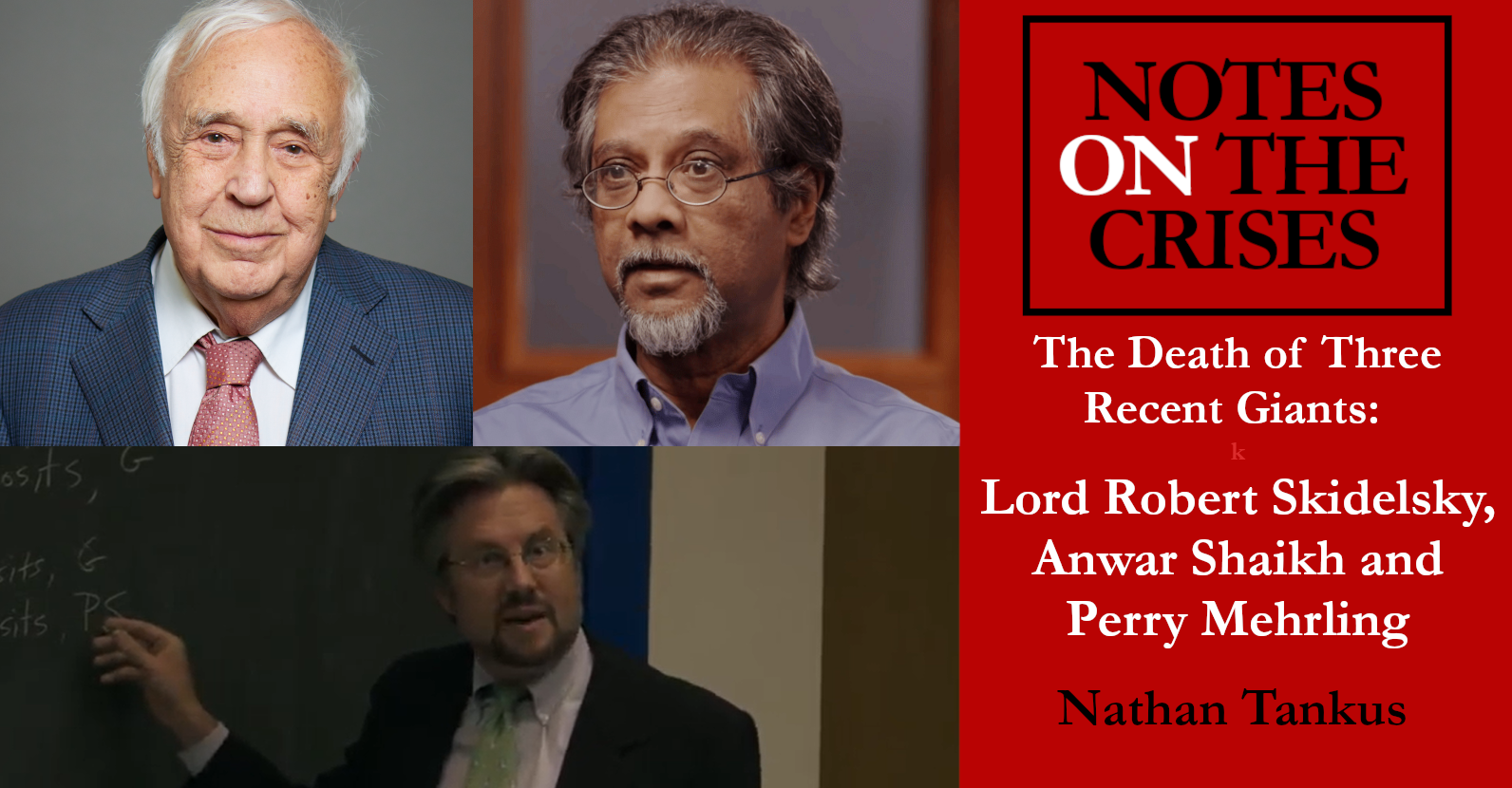
This year has been a difficult year for one of the corners of my world. It’s hard to even exactly describe what this corner is. The best way I can find to describe Lord Robert Skidelsky, Anwar Shaikh and Perry Mehrling is through a contradiction: they were all influential and marginalized macroeconomic thinkers. It hit me harder because I knew all these people personally. All deserve remembrance in their own right. They are all giants. But nothing will communicate the sadness and emptiness of a small corner of the world that doesn’t talk about each of them together.
I also have some stories and some personal connections that I want to get into print; so please indulge my nostalgia dear reader. I’m also remembering how gracious this corner of the world has been towards me from such a young age; taking me seriously when I had no right to be taken seriously and engaging me as an intellectual equal despite my lack of credentials. I would not be where I am today without so many people’s generosity and openness, which is especially remarkable for academics. With that out of the way, let’s get into it.
This is an excerpt from my 2022 book They Knew, which has drawn renewed public interest. There tends to be a four-year gap between when my books are published and when their conclusions are accepted. First came The View from Flyover Country (published in 2014; bestseller in 2018). Then Hiding in Plain Sight(2020 “shocking” bestseller turned 2024 conventional wisdom). They Knew is hitting right on time!
I also want to be straight with my readers: There is no new article this week because I spent it driving my recently deceased father’s car across ten states from my mom’s house to where I live. This was physically and emotionally exhausting. I’m very grateful for my subscribers. This week marks the third year of this newsletter, which is my livelihood, and renewals are crucial. I’m not slacking, just traumatized.
I will have a new article for you soon, as well as the return of the reader Q & A. To join that, or if you’d simply like to keep this newsletter going, become a paying subscriber:
The prize will be awarded to the best article in international political economy (IPE) published in 2025 (online first or in print) by an Australia-based scholar.
The overall winner will be selected from the shortlist by the selection committee, which this year comprises Ainsley Elbra, Anja Bless, Elliot Dolan-Evans, Tim DiMuzio, and me. The winner will be announced by December 2026.
The shortlisted articles are:
Hameiri, S., & Jones, L. (2025). International development financing in the Second Cold War: The miserly convergence of Western donors and China. Development and Change, 56(1), 3–30
Sturman, A. (2026). The capitalist state and critical agrarian studies: toward progressive strategy in the imperial core. The Journal of Peasant Studies, 53(2), 309–327
I really am—honest—trying to write a rather long and complicated book and don’t have time for things like this. But when one’s good name is impugned, sometimes thumos (to coin a phrase) gets the better of one.
Professional X Troll James Lindsay keeps dragging me into his every little fever dream. I almost always let it pass, though I did once demonstrate that he knows nothing about Plato, Carl Schmitt, or political philosophy generally.
Now he has committed yet another disastrous unforced error, on some level realizes it, and is spinning frantically to direct fire outward at everyone who has shown that he has once again made an utter fool of himself.
The nub is—literally—this: Amanda Milius, a filmmaker and former State Department official, recently gave a speech at the National Conservatism Conference in Jerusalem. For the record, I was not there and did not watch or read the speech. But I have known Amanda for eight years and doubt I would be surprised by the content.
I was born in 1989, on the cusp of the so-called End of History, as the son of two cultural historians specializing in the Middle Ages. These two datapoints, I think, probably explain a great deal about where my intellectual journey has taken me since.
I became fascinated by politics around age ten and my first political thoughts date from the early 2000s: the age of the War on Terror and the US-led invasion of Iraq. I was a precocious kid who didn’t know very much, but I knew I was somewhere on the left and felt an ambient sense of discontent with the world around me — a feeling, I hasten to add, that has not really faded with age. Indeed, the whole of my adult life has been punctuated by a never-ending series of economic and political crises: from the great crash of 2008 to the profound crisis of liberal democratic capitalism we face today. In many ways, both my academic studies and subsequent professional life as a writer have been about trying to understand these crises and make the case for an alternative.
Living in an age of economic, environmental and technological insecurity, and faced with the enormous power of tech billionaires, giant corporations, and unpredictable governments, people need to come together now more than ever. This in spite of the social isolation and political polarization so common to our time. We can overcome this with the power of the Many.
Politics and economics have been the key ways I have discovered and understood the world. It was my union that changed my life for the better. We campaigned against the privatization of Air Canada and the deregulation of the transportation industry. We fought contract concessions.
We were at the forefront of the anti-free trade battles in the 1980s and ’90s, educating and mobilizing the membership with an unparalleled intensity. After a narrow loss for the anti-free trade movement in that 1988 federal election, Canada firmly embarked on the neoliberal project.
Sadly, our predictions were true. Hundreds of thousands of workers lost jobs as businesses chased the cheapest labour, regulations were undermined, the tax base was eroded and public services pinched, with the iron dominance of global capitalist logic. And tragically, these same issues continue to plague us decades later.
I have been interested in the tension between capitalism, democracy and sovereignty for almost 40 years. I was politicized on these issues in 1988 during the FTA debate and they shaped my core political instincts, preoccupations and values. Capitalist societies inevitably lead to inequality, but the unequal distribution of wealth and power has grown to the breaking point in the past 40 years during the era of neoliberalism.
In my professional work today, these interests manifest in a focus on ownership and inequality, with the goal of identifying and advocating public policy change that will broaden and diversify ownership of assets in Canada and catalyze more investment into local assets that deliver social, community and environmental returns.
Over the past two years, the question of sovereignty and who controls key assets in Canada has of course become more central to my preoccupations. It has also made issues I care about more prominent on the policy agenda, like industrial policy, community and state ownership of assets, resilience of democratic institutions, social capital and civic trust, digital sovereignty, and the nature and impacts of foreign direct investment.
Coming of age in the 1970s, my early social and cultural politics were shaped by the simple but powerful anti-Americanism that was common in much of Canada at that time. Even in Alberta, where I was born and bred, there was a widely-held common-sense belief that Canada was a better place, blessedly free of war machines and ghetto scenes. We understood that Canadians had to be ready to defend those attributes against encroachment from U.S. multinationals, cruise missiles, and even tourists. (Only later, when studying economics, did I come to appreciate the economic stimulus provided by the hordes of American Winnebagos crowding the Rockies!)
Most of my first political activism fit within that broad frame of resisting American influence, and defending a diffuse and somewhat rose-coloured understanding of being Canadian. These included solidarity work with refugees fleeing the U.S.-engineered coup in Chile, protest against U.S. military testing in Alberta, and early activism against initial negotiations for free trade with the U.S. Indeed, as a result of speaking out publicly against the free trade negotiations, my first professional job came to an end and I started on a new career as a union economist. Perhaps that was a personal harbinger of the disruption that would upend millions of other Canadian lives once free trade became a reality.
Media release number 2026-29: Rachael Phelan has been appointed as Chief Risk Officer at the RBA, leading our Risk function and responsible for the delivery of the Bank's risk strategy.
In this special episode of Follow the Money, the Hon Dr Jim Chalmers MP, Treasurer of Australia, addresses the loss of control many Australians feel right now, the rise of the far-right in Australia, and the importance of meaningful reform.
This episode was recorded live at the 2026 Bernie Fraser Oration on Tuesday 13 October.
Guest: Jim Chalmers, Treasurer of Australia and Labor Member for Rankin // @jimchalmers
Host: Ebony Bennett, Deputy Director, the Australia Institute // @ebonybennett
I came here because supposed friends on the Right, as well as enemies on the Left, are slandering the great realignment that the American Right has been undergoing over the last decade, which led to the coalition that put Trump in office for the second time in 2024.
I noticed that by merely announcing online my plan to attend this conference, I have since been called both a Nazi and a sellout to the Zionists. This dual claim may not make logical sense, but it does give us a sense of what’s happening right now. People are trying to rip our coalition apart.
Many are now being encouraged to conclude that the New Right, the coalition that helped put President Trump back in the White House, and a whole generation of young conservatives have gone mad. And that story is no doubt very useful to the people telling it. The problem is that it’s just not true.
The National Security Strategy released last year describes President Trump’s foreign policy using these words: “realistic,” “pragmatic,” “principled,” “muscular,” and “restrained.” To quote: “It’s not grounded in traditional political ideology. It is motivated above all by what works for America—or, in two words, America First.”
New polling shows four in five Australian voters want a limit on rent increases, with majority support among both renters and homeowners across party lines.
More than half (55%) said rents should only be allowed to rise in line with inflation or less
One in four (23%) believe rents should be frozen temporarily
Only one in seven (14%) did not support a limit on rent rises
The majority of voters who own a home outright (71%), have a mortgage (73%) and rent (94%) want a rent freeze or cap
Action to freeze or cap rent increases has majority support across party lines and generations
The polling also shows the majority (75%) agree that governments should spend more money directly building public housing.
“Renter or homeowner, young or old, and whichever way you vote, the overwhelming majority of Australians want a limit on rent increases,” Everybody’s Home spokesperson Maiy Azize said.
“Renters right across the country are being pushed to breaking point. Rents are at record highs, and housing stress and homelessness are rising with them.
Ten years ago, I started asking questions about the census. Little did I know that I entered a Hotel California-esque vortex. Each question led to another question as I started to discover just how infrastructural the census is. Want to understand American democracy? The census is the key. Curious how to ensure data quality? The census has insights. Invested in responsible AI? The census has lessons. And on and on it went.
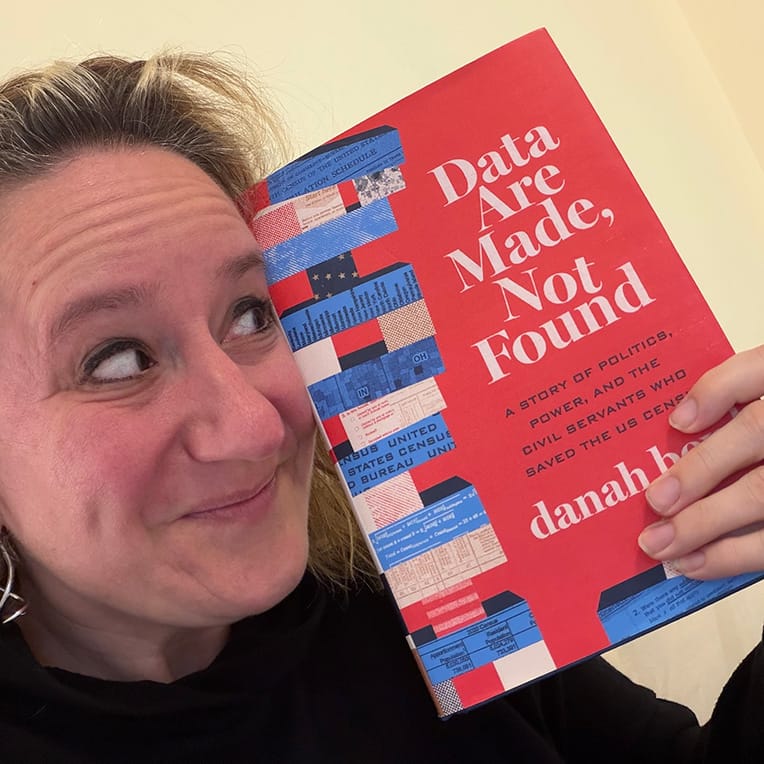
Well, today is the official publication day of Data Are Made, Not Found: A Story of Politics, Power, and the Civil Servants Who Saved the US Census, which is my attempt to use storytelling to explain the power and beauty of the census. The book is an account of the 2020 census, a love letter to civil servants, and a how-the-sausage-is-made story. Three arguments are woven through the book like red threads:
Australia could collect around $45 billion more each year from the finite mineral and petroleum resources it owns, according to a new report from the Prosper Australia Research Institute. The report, Australia’s Resource Wealth Giveaway, compares Australia with comparable resource-rich jurisdictions and finds that a fairer return is possible without stopping companies from making a […]
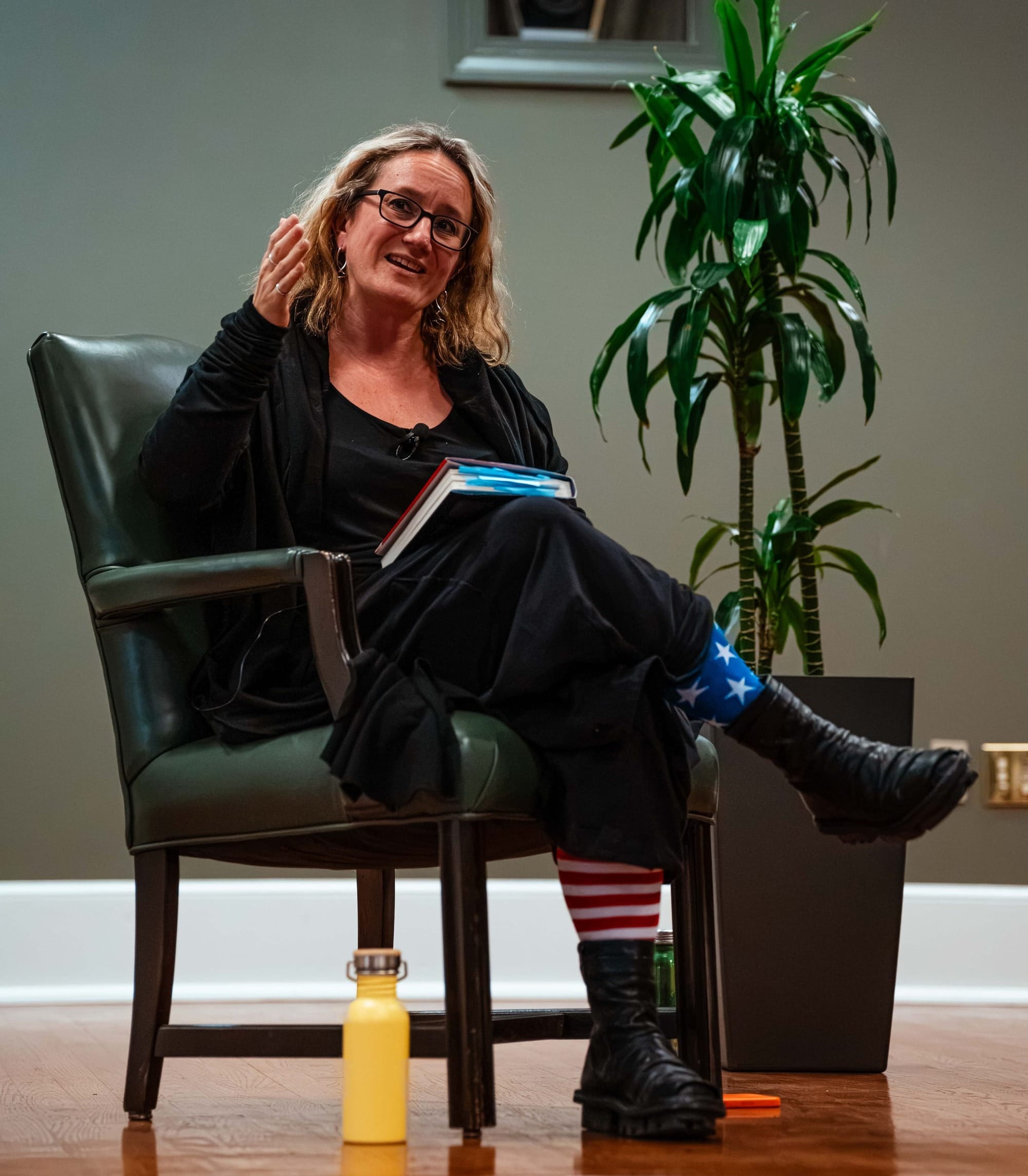
A few weeks ago, I launched my new book - Data Are Made, Not Found: A Story of Politics, Power, and the Civil Servants Who Saved the US Census. To my sheer delight, many friends have stepped up to host events and join me on stage and I'm now touring the country to spread the word about the census. (Seattle, DC, LA, Bay Area, Chicago, Ann Arbor: I'm headed your way real soon!) But when the team at Data & Society offered to host the first virtual event, I jumped at the chance. And I asked Dan Bouk, my dear friend and fellow D&Ser and census nerd to join me. He offered to make the idea of Jenga Politics understandable through a silly demonstration. I delighted in this, but I also begged a favor: would he consider crafting a silly song for the event?
A close friend, who once was instrumental for me to accept a job offer at my first job in Canada, has recently moved into a residence, where he is waited upon by health care staff that changes from day to day and comes at all unpredictable times of the day, walking into his luxury ‘suite’, bedroom or bathroom, regardless of his washroom needs or naptimes. The residence in Yorkdale, one of the most expensive, gentrified neighbourhoods in Toronto, is adorned by Whole Foods (owned by Amazon) and Ferrari (owned substantively by Enzo’s son, Piero, and the Fiat-founders Agnelli family’s investment holding company, Exor N.V.). The residence itself is owned by Canada-wide retirement home operating company with 30 residences under management. That operating company is further owned by a healthcare services management company headquartered in Tennessee. In its mission statement, the company expresses its commitment to “personalized care plans, strong clinical outcomes, and meaningful human connection.”
I became a political economist having lived my entire life through economic crisis. I reached voting age right at the time of the fall 2008 federal election that took place right as the Great Financial Crisis unfolded. Since then, Canadian and global economic crises have made regular occurrences, every few years or so, throughout my entire adult life – the 2011 European debt crisis, the 2014 oil price crash, Brexit, the COVID-19 Pandemic, and today’s overlapping polycrisis. Joblessness, wage and price mismatch, and precarity define the adult experiences of this generation. Crisis has been normalized, and the effects of this normalization are not well understood. Political economy, perhaps, as a generalist field has the best tools and ideas to comprehend these phenomena.
I also became a political economist to understand the causes of contradictions. Born at the end of history, the proclamation already seemed like a contradiction, coming from a working-class migrant background, growing up in advanced capitalist Canada. In this country, there are people who look like me, who spoke the Philippine languages I understood in the community, who make up one million members of Canada’s invisible working class today.
Peer Zumbansen interviewed me about the first steps Canadian political economists in the 70s took towards forming a movement with support from many different individuals, organizations, and neo-Marxist critical perspectives. It was revealing to revisit the issues which galvanized the rebirth of Marxist, Social Democratic, and Left thinking in Canada. These discourses also functioned as a framework for many other movements. This includes the environmentalists, feminists, and labor movements although this is not by any means an exhaustive list. In this interview/memoir, I go out on a limb and try to address its visible and not so visible impacts from my Toronto perspective.
Peer Zumbansen: Is political economy just a way of thinking critically about capitalism, or is it a belief about being on the right side of history?
10 Aug 2026 – Equality Australia says the 2026 Census marks a landmark moment for LGBTQ+ Australians, with new questions providing vital data to better understand the community and inform future policies, programs and services.
Instructions from the Australian Bureau of Statistics (ABS) arrived in letterboxes last month, ahead of census night on Tuesday when most households will fill it out online.
There will be separate questions on sex recorded at birth and gender, with the responses used to generate the first accurate data on trans and gender diverse populations. There is also a free-text field and 'prefer not to answer' option available for the gender and sexual orientation questions.
A separate question on sexual orientation will include a range of commonly used terms, and respondents can select the option that best describes them or provide a write-in response.
People with innate variations of sex characteristics, or intersex people, won’t be counted this census after the ABS did not recommend the question following extensive user testing.
Yesterday the Nobel Prizefake Nobel Prize the Sveriges Riksbank Prize in Economic Sciences in Memory of Alfred Nobel was again awarded. For the unique and bizarre history of this prize, see the piece I wrote five years ago pointing out that this prize was a form of “central bank fiscal policy”. But that’s not the topic of this piece. The subject of today’s piece are the awardees.
Returning from a long flight from Knoxville, Tennessee to Sydney on October 11 and arriving in Sydney in the early hours of October 13, it was with great sadness that I received the news that Peter Thomas had died in London aged 53. My inbox started flooding with the report that the cause was a suspected heart attack and my sincerest condolences and deepest sorrow remain with Sara Farris and their two children.
If all my recollected dates are correct, I first met Peter in 2006 at the Rethinking Marxism Conference and we continued that contact across numerous platforms ever since over the following twenty years. These included, of course, invitations at the University of Nottingham; appearances at the annual Historical Materialism (HM) Conferences in London; collaborations at Socialist Workers Party platforms organised by Neil Davidson in Edinburgh; co-participation at the Manchester Centre for Political Theory (MANCEPT) workshops; presenting at International Gramsci Society conferences in Cagliari, Sardinia; involvement at a Gramsci-specialist conference hosted in Büyükada, Istanbul; panels at the British International Studies Association (BISA), especially one hosted again in Manchester; and, not least, a workshop organised with Elizabeth Humphrys and Ihab Shalbak in 2015 hosted at the University of Sydney. The latter was themed on questions of method in Antonio Gramsci, anchored around Peter’s involvement as a plenary speaker. Plans were afoot to invite Sara and the family to Sydney for another workshop in 2022 but fell through due to logistical issues.
Journalist Ben Doherty joins Dr Emma Shortis to discuss Australia’s non-response to the Trump administration’s sanctions on the International Criminal Court, the American military footprint in Australia, and the OpenAI hack of Medicare on this episode of After America.
This episode was recorded on Monday 12 October.
Guest: Ben Doherty, Senior Reporter, Guardian Australia
Host: Emma Shortis, Director, International & Security Affairs, the Australia Institute // @emmashortis
The Enslaved Nashvillians Memorial Bench Dedication is the Nashville Scene’s 2026 Writers’ Choice for Best Commemorative Event in Nashville for its thoughtful ceremony.