I was relieved to be spared the last hour or so of class, and the unpredictably volatile temper of Mrs Ting. At any moment, a blackboard eraser could shoot across the room and strike with pinpoint accuracy the current target of her ire. A hushed silence would follow; a pause for dramatic effect; and finally the pronouncement like an Old Testament prophet that "You have the audacity to…!" commit whatever grave offence against classroom order.
We were a couple of years into the 1980s, but the concept of audacity had yet to be rehabilitated with any positive connotations.
So all up, I didn't mind the job of setting out chairs in the hall for something that was going on after hours. The something was euphemistically called "Life Education". I don't recall being aware it was something I was invited to, but as it turned out, after dinner, my father drove me back to school, and we took our expertly-arranged seats before a projection screen to watch a 16mm film.
As I realised what "Life Education" entailed, I began sinking lower in my chair with mortification. It was rather heavy on the colourful cross-sectional diagrams of reproductive organs, which struck me as a bit inappropriate. You can't be showing this sort of thing now; my father's here! This is tremendously awkward!
At the end of the ordeal, we filed out past a table of printed material.
"Do you want one of those books?" my father asked.
Dear God no! Just get us home, and we'll never speak of it again. And indeed that was the beginning and end of my parental guidance on the subject of sex.
It was redundant, in any case. The previous year saw a bold experiment in education: reorganising the classroom from rows of desks to clusters of six students to a table. I was put at (what with the benefit of hindsight was) an all-girl table, and my heavens, I have never laughed so much in my life. It was also the year my hair went curly. Given the content of much of the conversation, I'm surprised it didn't turn white and fall out. That year was quite enough sex education for the time being, thank you very much.
My parents were not big fans of desire in general. Wanting things was unseemly, hubristic. Audacious, even. Not the done thing. Far better to sit quietly and settle for what you have than make a fuss about what you don't. They were born just a little too early to qualify as boomers and had rather absorbed the values of the inter-war generation, as did I from them. This put a distance between myself and my peers. If you don't ask, you don't get, and I couldn't bring myself to ask for anything. I couldn't believe that people like us were entitled to do so.
As a result I was a curiously inert child in the midst of a boisterously self-assertive crowd. Add neurodivergence and the wrong puberty into the mix (neither of which were at the time well understood, certainly not in my suburb), and I wasn't exactly set up to flourish in my teens.
My coping strategy was to feign indifference to anything I actually craved, and to present a small target for bullying. I didn't just pretend I was amorously disinterested in girls (and obviously boys), but also indifferent to approval and companionship of any kind. My consoling solitary interests were not of the "normal" kinds for someone of my age, social station, and apparent gender, and when discovered would quickly become the subject of ridicule, so my joys, such as they were, were limited and kept secret. I longed to disappear from view entirely. If my parents had an inkling of how small a footprint I was endeavouring to make upon the world, they would have been proud.
However my peers were canny enough to have realised that I must have at least some of the usual human needs, and they were able to lever that insight into entertainment. One memorable example from the daily barrage: Once when I was awkwardly loping my way past a bus stop, three schoolgirls sitting there noticed me and promptly began to mime gagging, retching, and vomiting, until they could keep it up no longer and fell about in uncontrollable hilarity.
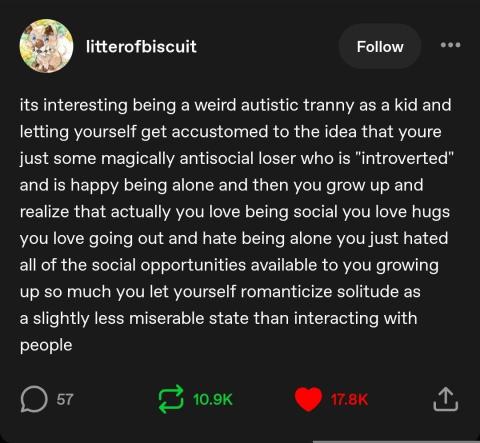
The message, already well internalised, was that I was fundamentally, disgustingly, repellent and ought not have the audacity to even attempt to integrate with decent society. At least not unless and until I had redeemed the awful liabilities that nature had imposed upon me. So I didn't just keep my desires secret, I persuaded myself that they didn't even exist.
The important general questions that may be asked (because this is not about me, she insists) are about how a community can reach an immediate unspoken agreement on who constitutes a legitimate target for such treatment, and what the acceptable limits of the treatment are (i.e. why a vicious beating in one context, public humiliation in another, and a steady drip of degrading insults and ridicule elsewhere?).
Moreover, what benefit do aggrieved representatives of the social order derive from their unwavering obligation to police and punish? Is it just a gleefully sadistic group bonding exercise? Are they seriously intent on forcing the offenders out of their community, one way or another?
As far as my own experience goes I don't have any definite answers, and I'm rather glad I don't, so I leave this as an optional exercise for the reader during their next bout of insomnia or whenever.
Fast-forward forty-odd years. I was still some years away from being out of the closet. And living in a former seaside motel complex among assorted divorcees (myself having just joined that club), along with stoners, meth dealers, and violent and unpredictable former tenants of Her Majesty. My libido was in the midst of a years-long coma from which it appeared unlikely to recover, to the grief of nobody, least of all myself.
Relaxing one afternoon (as much as possible in the circumstances), I happened to read something online which brought my scrolling to a sudden halt. I wish I had thought to save it, but to paraphrase from memory, it went something like:
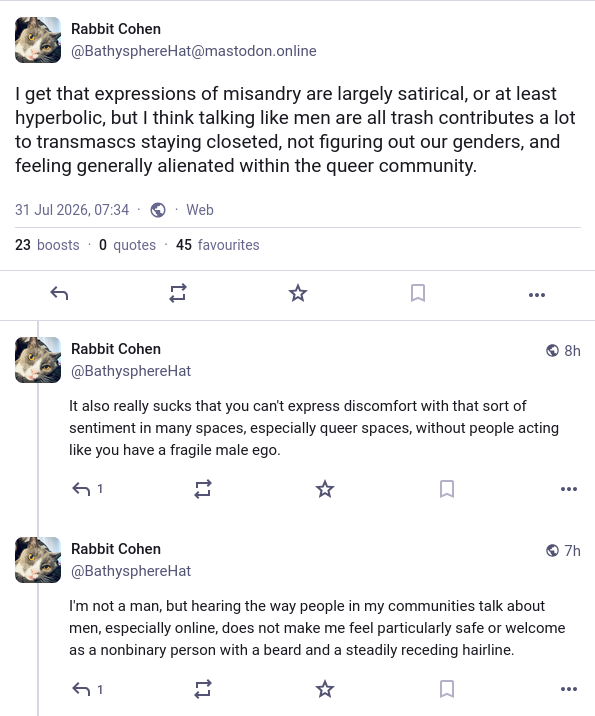
"Can we all please stop making jokes about how men and testosterone and masculinity are nasty and poisonous and icky? There are a lot of trans men about here, and it is really cruel and degrading."
And I realised to my shame that I had never even considered this. So I couldn't say that I had never done it. And the thought is indeed mortifying. Here are these poor fellows who are either at some point on the way to sorting themselves out, or they've finally achieved some equable state of affairs, and the very things which are for them miraculous and life-saving — including some of the most fundamental attributes that make them who they are — are considered grounds for disgust and moral condemnation.
It is not reasonable, much less amusing, to wage a personal vendetta against a molecule, or an "M" on a passport, or a chromosomal combination, or a label for a loose culturally and historically contingent cluster of personality traits.
While all of those had been proximal causes of my distress for most of my life, the root cause (setting aside patriarchy, all the evils that flow from it, etc.) was gender incongruence. It was not that there was something intractably horrible about being a man; something which others could cope with better than I. It was simply that I wasn't a man.
One's gender isn't a moral or political choice. Indeed it's not a choice at all. Nor indeed is one's sexuality. This much is trivially self-evident.
Skip ahead another few years in my glamorous and thrilling autobiography, and I've moved to Melbourne, started hormone therapy, had my name legally changed, started a postgraduate degree (did not see that one coming), and I'm pretty comfortably a member of what you could consider two distinct communities, both of which are overwhelmingly cishet.
I've had virtually no non-trivial adverse reactions anywhere I've been. For the first year or so I was pretty regularly inadvertently misgendered, but that happens rarely now — I think mainly due to the effect that the sedentary life of a student, plus progesterone, have had on my backside, which is now quite unmistakably matronly. (If you think that's too much information, you should probably stop reading here.) Was once passed in the street by a man who complimented me on my handbag with less than total earnestness. I should have walloped him with it. Occasionally I get what appears to be a snooty sideways glance while washing my hands in shopping centre loos.
I'm sure this gentle ride is largely because I live in the inner suburbs, and I do not stray very far from home. Any clear public display of transphobia (or any other bigotry) is unlikely to be well received here. There's a reason that neo-nazis are given a complimentary police escort whenever they visit the city.
Despite being (quite visibly) trans, over the last few years I have rarely felt socially uncomfortable, though I am sure that most of my friends and acquaintances here had never had any sort of sustained social interaction with a trans person before meeting me. Occasionally somebody will very gingerly ask about it, or else will come out with some very dated misinformation, and I'm happy to offer what information I have, provided they're genuinely interested.
Overwhelmingly, since social transition, I have been treated first as a person deserving of dignity, and whatever else people think of me occupies some place further down the list. At no other point in my life have I felt as warmly and readily accepted, or as sincerely appreciated as I do now. It is magical. I get teary just thinking about it.
The outstanding exceptions, ironically, have been among trans women.
Continued in part two…