On this episode of Dollars & Sense, Greg and Elinor discuss the pay increase for childcare workers, what’s happening in the stock market and the decision to keep interest rates on hold.
Greg Jericho is Chief Economist at the Australia Institute and the Centre for Future Work and popular columnist of Grogonomics with Guardian Australia. Each week on Dollars & Sense, Greg dives into the latest economic figures to explain what they can tell us about what’s happening in the economy, how it will impact you and where things are headed.
Host: Greg Jericho, Chief Economist, the Australia Institute // @GrogsGamut
Host: Elinor Johnston-Leek, Senior Content Producer, the Australia Institute // @ElinorJ_L
Theme music: Blue Dot Sessions
We’d love to hear your feedback on this series, so send in your questions, comments or suggestions for future episodes to podcasts@australiainstitute.org.au.
Are the home affairs and immigration portfolios a poisoned chalice for the new minister, Tony Burke? And are the opposition’s attacks on the government over the economy having an impact ahead of the election? On this episode of Follow the Money, we discuss the latest in federal politics with Paul Bongiorno.
This discussion was recorded on Tuesday 6 August 2024 and things may have changed since recording.
Guest: Paul Bongiorno, columnist, The Saturday Paper and The New Daily // @PaulBongiorno
Host: Greg Jericho, Chief Economist, the Australia Institute // @GrogsGamut
Theme music: Pulse and Thrum; additional music by Blue Dot Sessions
We’d love to hear your feedback on this series, so send in your questions, comments or suggestions for future episodes to podcasts@australiainstitute.org.au.
New APRA figures show the impact the Reserve Bank’s program of official interest rate increases has had on the Australian economy.
From the low of 0.10% in April 2022, official interest rates have increased by 425 basis points to 4.35%. Thankfully the Reserve Bank has this month kept rates steady, but the damage to the economy has already been done.
Since the March quarter of 2022, quarterly interest payments to the banks from the rest of the Australian economy went from $25.8 billion to $78.95 billion in March 2024. If we annualise these figures that means there has been a $212 billion increase in payments to the banks since official rates were increased.
Since that low of March 2022, each 25 basis point increase in the official interest rate increased banks’ annualised interest charges by around $12 billion. For comparison that is slightly more than the Australian government is budgeted to spend in this financial year on support for carers.
Over the same period, quarterly payments to the banks for home loans increased from $13.5 billion to $32.8 billion. The increase of $19.3 billion per quarter equates to just over $77 billion per annum. It also means that each 25 basis point increase in the official rate increases annualised interest charges on home loans by $4.5 billion per annum. Each 100-basis point increase increased the banks’ annualised interest charges on home loans by $18 billion.
In the wake of the Reserve Bank’s latest forecasts, Treasurer Jim Chalmers is facing calls to cut back infrastructure investment to relieve inflation pressures and ramp up housing construction – cutting back on fossil fuels is an easy first step to address this problem.
Patricia Karvelas peppered the Treasurer with questions this morning, asking whether there is there anything the government can do to slow “non-essential projects” to “allow flow back to housing”.
The short answer is yes. There is one particular kind of infrastructure the government can cut back on first: fossil fuels.
Every time the government approves new coal mines or gas expansions, it’s giving the go ahead to projects that soak up labour and equipment — taking resources away from the construction of essential infrastructure like dwellings, roads, and railways.
Some $41 billion worth of new fossil fuel projects are gobbling up the construction supply chain.
Recent research by the Australia Institute using official government data has found that fossil fuel projects make up 53% of the total funding committed to resource and energy infrastructure across Australia.
Woodside, for example, has committed an estimated $18 billion to oil and gas projects in Western Australia; Santos $4.3 billion to the Barossa gas project in the NT. Further billions are flowing to coal projects in NSW and Queensland.
Washington DC-based international policy expert Dr Nancy Okail joins Dr Emma Shortis on this episode of After America to discuss America’s relationships with China and the Middle East, and possibility a more progressive approach to foreign policy led by Kamala Harris.
This discussion was recorded on Friday 2 August 2024 and things may have changed since recording.
Guest: Nancy Okail, President and CEO, Centre for International Policy // @NancyGEO
Host: Emma Shortis, Senior Research for International & Security Affairs, the Australia Institute // @EmmaShortis
The wording of the Western Australian Government’s fact sheet on petroleum resources exemplifies the way in which the country’s resources are described to the public:
“Petroleum resources are owned by the community and a royalty is a purchase price for the resource. The community expects a fair return for the loss of its non-renewable petroleum resources.”
This rhetoric does not reflect reality. While the community might expect a fair return for the loss of its resources, in many cases it gets no return at all, fair or otherwise.
Australia has ten facilities that export gas as liquified natural gas (LNG). Six of these projects—both of the Northern Territory’s facilities and four of the five operating in Western Australia—pay no royalties, either state or federal. These facilities represent 56% of Australia’s gas export capacity. This means that all the gas exported from the NT, and more than half the gas exported from Australia, is given for free to the companies exporting it.
The monetary value of this gas is enormous. The total value of LNG exports over the last four years is estimated at $265 billion Australia-wide, $37 billion of which was exported from the NT. All of the NT’s LNG exports were royalty-free and Australia’s royalty-free exports totalled $149 billion. To put this another way: in the last four years alone, Australians have given away the gas that made $149 billion worth of LNG, for free.
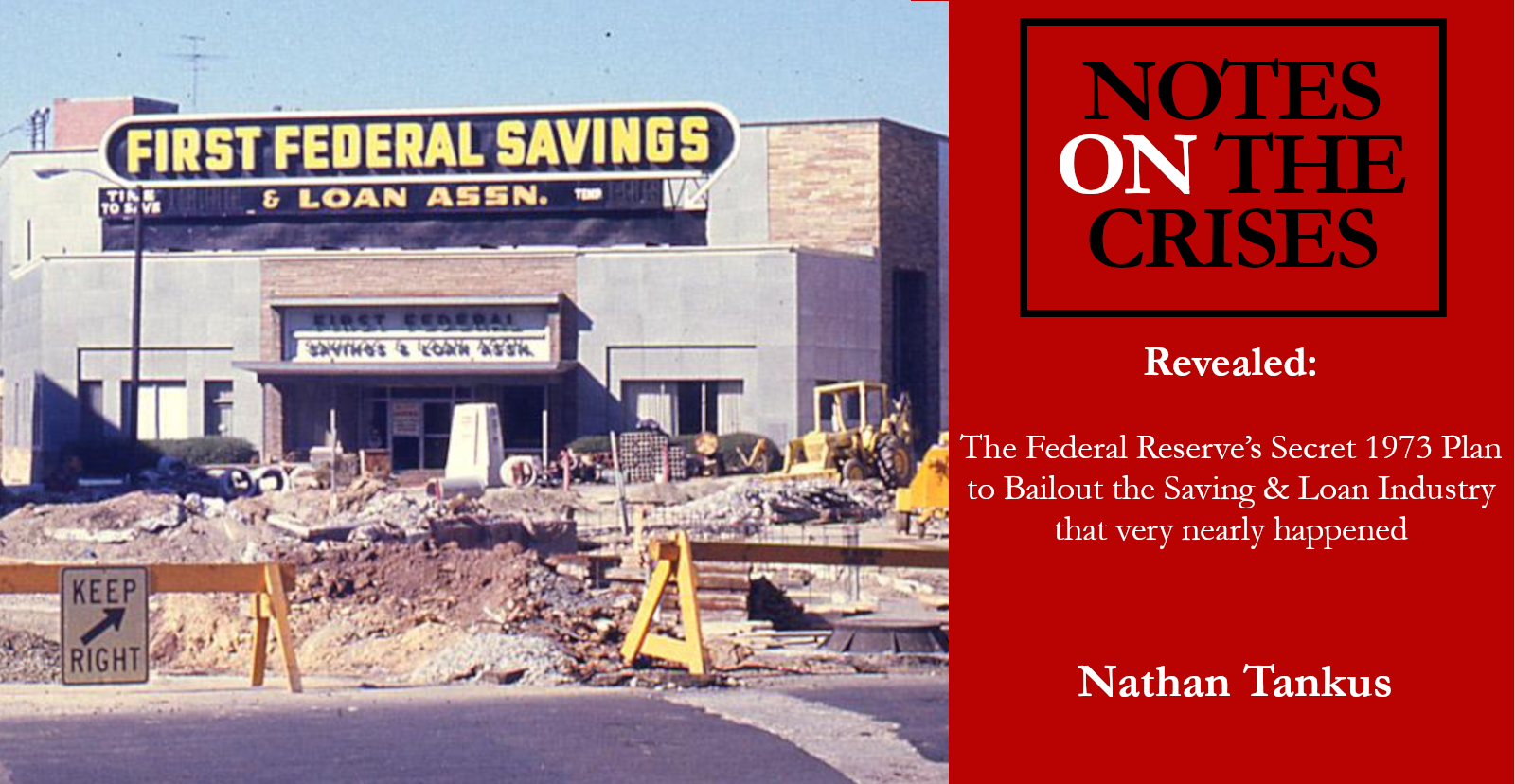
I apologize for my long absence. I’ve been consumed with archival research in both the National Archives, Freedom of Information Act (FOIA) Requests and Online Archives. My next piece explains, and releases free to the public, 30,000 pages (!!!) I recently got from the Federal Reserve Board through FOIA. More generally, I am going to write quite a lot in the coming months on what I’ve unearthed in all that research. I hope that you will stick with me in this process.
This is a Premium Piece of Notes on the Crises. Thank you for being a Paid Subscriber
Over the past eight months, I’ve been increasingly focusing on Freedom of Information Act Requests of the Federal Reserve System. What attracted me to this kind of work is the realization of how much material is not publicly accessible — simply because there has not been very much interest in focusing Freedom of Information Act requests on the Federal Reserve. But I’m very interested.
Nathan Tankus writes about a secret phone call between Paul Volcker and Federal Reserve Chairman Arthur Burns to save the Treasury from debt ceiling driven default
Readers may recall that I wrote a Politico Op Ed at a critical moment in the debt ceiling showdown. That piece, was entitled “Biden Can Steamroll Republicans on the Debt Ceiling”, and I aimed squarely at debunking the idea that the Federal Reserve would step on any “unilateral actions” to avoid treasury default. My key piece of evidence was a memo that I had not read, and was not publicly available. But I knew the contents of the memo indirectly through the Federal Open Market Committee Meeting transcripts. Those comments were in some ways especially revealing, since they came from the Fed’s three leaders: Ben Bernanke, Janet Yellen and Jerome Powell. It’s worth quoting the key part of my Op Ed at length:
On March 16th 2023, the Thursday after Silicon Valley Bank Failed, I published a piece entitled “What's going on with Treasuries? Silicon Valley Bank and the incoherence of the Federal Reserve's (lack of) an interest rate policy this week.” The central premise of this piece was that a lack of forward guidance was creating uncertainty in the treasury market as participants were unclear whether the Fed would be hiking because of inflation, holding because of financial stability or even outright cutting interest rates. This uncertainty in turn, I argued back then, was causing treasury market issues. I argued it was those issues that led to a breakdown of liquidity similar to 2020 and so called “repo madness” in September 2019. There is nothing logically wrong with its central argument. The problem with my old argument is simply that it's empirically false.
Long time and close readers of Notes on the Crises will be aware that I’m a Modern Monetary Theory (MMT) scholar. More than three years ago now I published written remarks of a talk I gave to a Federal Credit Union which laid out my (brief) articulation of some of MMT’s core ideas, and how those insights related to the then-raging Coronavirus Depression. Nevertheless, I tend not to write about MMT explicitly for Notes on the Crises. Nor have I written about theoretical debates among non-mainstream economists more generally in this newsletter. I have usually sought out other publications to do that kind of writing.
I'm very excited to announce that I'm under contract with Viking Press of Penguin for my book on the Federal Reserve entitled "Picking Losers". I'm sure I will write about some of the themes of the book (especially the more technical aspects which are too technical for a popular press book) in Notes on the Crises over the next eighteen months or so of writing, research and work I will be doing to write the book. The book sale itself is the culmination of years of work from the very beginning of the newsletter as I traced many of the themes I've written about here all the way back to World War Two. As always, thanks to the generous readers who have made this possible.
In other exciting news, I had an Op Ed last week in Politico on the debt ceiling entitled "Biden Can Steamroll Republicans on the Debt Ceiling- And Fed Chair Jay Powell won’t interfere". It was extremely exciting to tell the story of "Defaulted Treasury Securities" and the Federal Reserve's reluctant willingness to buy them. Here's how the Op Ed opens:
It’s five weeks to the day since the bank run on Silicon Valley Bank. In that time, intellectual fault lines have solidified. At first dazed, the centrist banking scholars have rallied. In their view many things need fixing. Banking supervision, banking regulation, credit rating agencies, auditors and irresponsible creditors all need fixing. The one thing that does not need fixing: deposit insurance. As the panic has subsided from our mini-panic, the old attacks on deposit insurance have come to the forefront. The age-old claim that deposit insurance “punishes” sound banks (through greater insurance charges) and uniquely encourages irresponsible risk taking have returned with a vengeance. The latest missive comes from the Brookings Institution’s Aaron Klein. Klein's latest, published in the Wall Street Journal, is a piece entitled: “Why FDR Limited FDIC Coverage: The objective was to protect depositors, not rich people and big companies”
This is a free piece of Notes on the Crises. Pieces will remain free until I feel the fallout from Silicon Valley Bank has fully settled down. To support pieces remaining free, please take out a paid subscription.
Before Silicon Valley Bank failed last week, I was considering writing a post examining the Federal Reserve’s policy framework in the context of the last sixty years of monetary policy’s history. That kind of analysis is now newly relevant, perhaps even urgent given the Federal Open Market Committee (FOMC) meeting today, and the press conference Chairman Powell will hold tomorrow. Recall that the FOMC is the committee that determines monetary policy within the Federal Reserve.
Today it is widely accepted that the Federal Reserve uses one main tool (interest rates) to affect the economy through the “channel” of “financial conditions'', in order to accomplish its twin goals of high employment and low inflation. Of course, in practice, it’s choice between those two goals when they conflict leans much more heavily towards inflation. In some historical periods, it seemed to be the case that they only cared about inflation. However, that is not what this piece is about. Instead I want to focus on those first two parts: tools and “channels''.
Normally I do not release pieces on Saturdays or Sundays. However, this is the third anniversary of the first piece I ever sent of this newsletter. That brief note, appropriately titled “Sign of the Times”, was more like a glorified social media post than a newsletter. As I said in that very first piece “This is the big one and I think everyone now realizes that”. I am enormously proud (and still bewildered) by how much I was able to subsequently write for those first four months. I covered nearly every complicated step of what happened.
More to the point, I'm still shocked by how overwhelming the audience response was — culminating in a globally translated viral profile in Bloomberg Businessweek. Still, even three years later, I am not used to how much my status has changed personally — and how many people now take my opinion very seriously. I can’t ever express how grateful I am to all my readers. You have all changed my life forever.