Bryan, Ohio, is a fine small town. It’s the kind of place where holiday dinners are potlucks, featuring several versions of homemade meatloaf and bean casserole, and the cooks silently watch to see which desserts are gone first. It’s as flat as a sheet of plywood, and the wind bites bare skin in the winter.
Dad’s Place, a storefront church run by Pastor Chris, occupies an old building a few doors down from the county courthouse. It looks like plenty of other businesses that haven’t yet spruced up their early-20th century buildings. Mentally ill and homeless people shelter in the church, which is open 24/7—but the day of my visit, the local City Hall got a court order to shut it down. The temperature dipped to 16 degrees that night.
Pastor Chris founded Dad’s Place years after his conversion to Christianity in mid-adulthood, after which he entered ministry. He describes his reluctant conversion this way: “It was like a nuclear bomb went off. I can’t describe it—nothing around me happened, I didn’t hear a voice or anything like that.” His eyes welled up at the memory. “But everything changed in that moment.”
Inside of Dad’s Place, there’s a front room that faces the street, with just a table and some chairs. Anyone can walk in off the street. There’s always a live or recorded sermon playing for customers.
Japan and Australia enjoy a long-standing relationship when it comes to energy trade. According to Japan, “(t)he energy and resources sector is the bedrock of the Japan-Australia economic partnership”. But the two countries’ efforts to decarbonise their economies to reach their respective emissions reduction targets have been threatening to jeopardise this gas-fuelled obsession. Japan has been lobbying hard against any change to fossil fuel regulation in Australia. Now, under the guise of Japan’s Asia Zero Emission Community (AZEC), Japan and Australia have found a new way to keep the relationship going.
On paper, AZEC serves as a platform to support achieving net-zero emissions across the Asia-Pacific region. AZEC allows its 11 partner countries to benefit from Japanese funding for energy projects. Through AZEC, Japan aims to lead the energy transition across Asia. Research by Zero Carbon Analytics shows that, since AZEC was launched in March 2023, 158 project agreements have been signed across the Asia Pacific. Prime Minister Albanese took part via video message in the inaugural AZEC leaders’ summit in December 2023.
The people of Australia collectively own all the resources under the ground. This means that the coal in NSW is the property of the Australian people too.
Because of this, mining companies have to pay the NSW Government a “royalty” if they want to dig up and sell coal.
Royalties are not taxes. They are a payment for a resource. Just like a builder has to pay for the bricks used to make a house and pay tax when they sell the house, mining companies have to pay royalties for coal and then pay tax once they sell it.
If NSW were a country, it would be the third-largest exporter of coal in the world, smaller only than Queensland and Indonesia. With all that coal production, the mining industry and politicians frequently claim that coal royalties are large enough pay for services like schools, hospitals, teachers and nurses.
“[Coal] is the state’s largest export commodity, and is a major source of revenue, which the NSW Government uses to help fund essential services and infrastructure such as schools, hospitals, roads and transport.”
In the hamlet of Remsenburg, Suffolk County, Long Island, New York lies a small cemetery behind the chapel of the Remsenburg Community Church. There one finds the modest final resting place of a great American, marked by a substantial rectangular headstone with a large open book sculpted on top, in which is inscribed from top to bottom:
Jeeves
Blanding’s Castle
Leave it to Psmith
Meet Mister Mulliner
Beneath this on the wide headstone you see the name of the great American:
Sir Pelham Grenville
WODEHOUSE
At the very bottom of the headstone are the words:
HE GAVE JOY TO COUNTLESS PEOPLE
Seldom have truer words been engraved in stone. Pelham Grenville Wodehouse (Plum to his friends; P.G. to his reading public) gave joy to countless millions of people with his books, about a hundred of them, written during the first 75 years of the 20th century. So long as people and books are to be found, he will continue to give joy—the joy of pure soul-refreshing laughter—by inviting his readers into the worlds of Jeeves, Blandings castle (not Blanding’s as on the headstone), Psmith (with a silent P as in ptarmigan), Mr. Mulliner, and other immortal comic characters and settings.
The Albanese government’s attempt to rush through major changes to Australian elections has been delayed in the Senate – at least until February, perhaps forever.
As Australia Institute research identified serious flaws, risks and loopholes in the legislation, delay is welcome – but bittersweet, because electoral reform is needed to increase confidence in politics and democracy.
Good electoral reform would include transparency around political contributions, especially “cash- for-access” payments from vested interests to get exclusive access to politicians; truth-in-political-advertising laws to prevent political players from misleading the public; and upper limits on billionaire and corporate spending on political campaigns.
But the government proposed changes that are flawed in process and substance. Though Special Minister of State Don Farrell has had almost three years to prepare the bill, the 200-plus page behemoth was presented to Parliament with just days for consideration.
Daniel Penny enjoyed a well-earned beer more than a year too late. After protecting dozens of New York City subway passengers from the violent fantasies of Jordan Neely, Penny was punished at the hands of activist Manhattan District Attorney Alvin Bragg. Though he escaped a heavy punishment—spending the prime of his life rotting away in jail—for Penny and others like him, the process is the punishment. The stress of a grueling trial, the financial toll brought on by his parents fronting an $100,000 bond, and the reality that many Americans taken in by the media’s lies think Penny got away with committing a lynching in broad daylight—all of this will serve as a stern warning to men who dare stand up to the lawless tyranny in many of America’s major cities.
A regime that allows an army of Jordan Neelys to harass and threaten its citizens, and then tries to make an example of any man who dares try putting a stop to it, is a regime infused with a deep-seated hatred of masculinity. This makes sense given that masculinity is what will protect the innocent from the regime’s open embrace of lawlessness.
A decent society would honor Daniel Penny. Instead, our elites dragged him through a sham trial that ended in an acquittal despite their most brazen efforts. In a regime of lawlessness, citizens who enforce order are the enemy.
A well-functioning society possesses an inherent will to survive. Daniel Penny’s grave mistake was assuming he lived in such a place.
As campaigners and organisers, we know stories of lived experience are powerful, and we’re eager to involve the community in our storytelling. But how do we do this meaningfully and with care?
This resource includes tips, tools and a presentation from a workshop session for digital storytellers and organisers working with affected communities.
The workshop was led by Zenaida Beatson and Kristin Gillies from For Purpose, a social enterprise from Aotearoa. They shared a framework and lessons on ethical storytelling with community including case studies from campaigns in Australia and New Zealand.
This workshop was hosted at a conference by Australian Progress called FWD+Organise 2024 and was held in Naarm/Melbourne.
Below are some tips and tools from their workshop session, and you can also access their full slide presentation below.
In late November, at the start of Parliament’s last – and busiest – sitting week, the Australia Institute and community organisation Grow it Local launched a report showing that Australians simply love growing food.
Our organisations partnered to conduct a national survey on Australians’ food growing habits and attitudes towards food waste. The results show that a whopping 45% of Australians—around 9 million people—are growing food at home, and even more are interested in starting edible gardening. And it’s not just a passing trend: a decade ago, the Australia Institute conducted a similar survey which found that one in two Australian households were growing food – to produce healthier food, to save money, and simply because they enjoy it. These results show that growing food is a lifestyle choice driven by the desire for healthier food, to save money, and to live more sustainably.
As the days get longer and the nights warmer, find yourself a cool place to lounge back and immerse yourself in some of the books we have picked out for our annual progressive summer reading list.
Here are our favourite books from 2024 to keep you entertained over the summer.
The research will be sent to the NSW Treasury, as a pre-budget submission ahead of the 2025-2026 state budget. Submissions close today.
Key points:
Coal royalties have averaged only 2.4% of NSW Government revenue over the last decade.
In 2023–24, coal royalties were 4.2% of total NSW Government revenue, with global coal prices pushed up by Russia’s invasion of Ukraine.
All coal resources in NSW are publicly owned, and royalties are the price that mining companies pay the public to extract the resource.
Royalties do not fund specific programs — they are grouped with the rest of government revenue. This means that over the last decade, coal royalties have funded only 2.4% of every teacher or nurse.
No money has yet been spent from the Royalties for Rejuvenation Fund, the NSW Government program which theoretically redirects royalties back to coal-producing regions.
“Coal companies and politicians keep telling us that coal royalties are huge, and that they fund schools, hospitals, and regional communities all across the state. This report shows that these claims simply aren’t true,” said Rod Campbell, Research Director at The Australia Institute.
“Coal royalties fund a tiny proportion of every school, hospital or regional community. They are not propping up the economy.
“The NSW public owns coal resources, but they aren’t getting their fair share of coal mining revenue. The real money is flowing into the pockets of big corporations.
Seen for a political economic perspective, there’s always lots of topics needing analysis. This is evident in the array of articles in the new issue of Australia’s leading political economy journal. Topics include debates around green growth; the wages of childcare workers; the management of water; new industry policy interventions; taxing giant tech companies; and tensions between social democracy and neoliberalism.
Almost certainly, the most controversial article will be the first one: assessing what’s at stake in debates between advocates of ‘green growth’ and ‘degrowth’. Written by Tim Thornton, it identifies sources of confusion underlying the different viewpoints, suggests a typology of positions taken on ‘economic growth versus the environment’, and seeks to identify potentially common ground. Given the intensity with which some participants in these debates hold their positions, it is probably unrealistic to expect a cosy consensus to result. Hopefully though, Tim’s article will be widely read and discussed; and further submissions and rejoinders on this important topic could be featured in future issues of the journal.
If you get caught speeding in Australia, you will be fined with a flat-rate traffic fine. Exceeding the speed limit by 12km/h in New South Wales earns you a $361 fine, whether you are on government benefits or a billionaire. This is not a fair system.
What about the principle: same offence, same price?
If you earn $50,000 a year, a $361 fine is equal to more than a third of your weekly salary. If you earn $200,000, it is less than 1% of your weekly salary.
So, while a speeding fine is nothing more than annoying to a wealthier person, someone on a low-income might have to choose between paying the fine and a medical bill or food.
A minor fine left unpaid can lead to a vicious circle of accrued debts, leading to a loss of licence and further loss of income. In some cases, it can even lead to jail time. Unpaid fines are in fact one of the top concerns for people seeking legal aid.
Australia Institute research shows that a proportional traffic fine system, as is in place in Finland, would be much fairer. In practice, the Finnish system calculates a fine based on the driver’s disposable income and whether they have dependents. Same offence, same proportion of income.
Tips and an example checklist for community organisers about planning and promoting an event such as a town hall. This resource comes from a conference session called Town Halls and Turning People Out in 2024.
The conference—FWD+Organise 2024—was held by Australian Progress in Naarm | Melbourne. The session was run by Carly Robertson from the Australian Conservation Foundation and Caitlin Gordon-King from Huddle.
In the session, Carly Robertson, a community organiser with the Australian Conservation Foundation (ACF), shared lessons about ACF’s ‘organising playbook.’
ACF Community Groups
ACF uses a decentralised organising framework and has 43 groups (as of Dec 2024) around Australia. (See Map) The community groups are a network of independently organised, volunteer-run groups in the ACF community and are supported by paid community organisers. The community organisers provide support by:
This article is read by Eunice Wong, a Juilliard-trained actor, featured on Audible's list of Best Women Narrators. Her work is on the annual Best Audiobooks lists of the New York Times, Audible, AudioFile, & Library Journal. www.eunicewong.actor
As far as I know, the only institutional reaction from American law schools to federal results from the 2024 election has been to tell foreign law students to get to campus before Trump's inauguration, part of broader warnings from universities and colleges. I can find no record of law schools holding conferences on how to teach law when all three branches of the U.S. federal government will be controlled by officials and judges expressly opposed to rule of law and the design of the U.S. Constitution. There is no news of curricular overhaul to meet this moment, no reports of revamped legal ethics courses considering how, if at all, ethical attorneys can practice law in this environment. The Association of American Law Schools, U.S. legal education's main professional organization, has not issued any statements about what "excellence in legal education" might require when the federal legal system is about to be controlled by fascists.
In January, 2020, the Equal Rights Amendment (ERA) was ratified, per the procedures specified in Article V of the U.S. Constitution. As with all U.S. law, the U.S. Constitution is the paramount authority on the law of amending the U.S. Constitution. So, when Virginia became the thirty-eighth state to ratify, the Amendment was lawfully ratified and it became part of the U.S. Constitution. Where was the fanfare? The celebration? Why was a woman's constitutional right to abortion relitigated in 2022 as a question of due process rather than a question of women's equal right to choose their own medical care and to bodily autonomy?
Since the election, some legacy media, Democratic electeds, and formerly anti-Trump commentators have been quick to appease Donald Trump and to normalize his proposed nominees and policies. This is sickening. It is craven, unprincipled, and dangerous.
Those of us committed to opposing Republican Fascism must identify and support actors who gathering courage and resources for the struggle. As I find people, causes, and organizations that get it, I will share them here at Heidi Says. I have two so far: Marc Elias and his organization, Democracy Docket; and Biden Publish the ERA, a coalition of groups working to get Biden to direct the U.S. Archivist to publish the Equal Rights Amendment.
Marc Elias is a long-time leading attorney for voting rights and ballot access. I have been acquainted with him and his work since 2008, and he is one of the smartest, shrewdest, and most committed lawyers I know. After a successful career with Perkins Coie, he started his own law firm to dedicated to voting rights and founded Democracy Docket. Yesterday, Marc wrote:
About once a decade, I need to consult the Charter and Bylaws of the Democratic Party of the United States. As a rank-and-file Democrat - registered to vote as one - this is always remarkably difficult. That tells you much of what you need to know about the relationship between the rank-and-file and the Party: the Party is a private organization, with no obligation to disclose its organizational documents to people just because they are registered Democrats.
This time around I went hunting for a copy of the latest Charter and Bylaws, which is from 2022, because somebody asked me how we rank-and-file Democrats can encourage the Democratic National Committee to make Ben Wikler its chair. Currently the Chair of the Wisconsin Democratic Party, Wikler would be a great national Chair. But that's a topic for another day. Today is for explaining why it is that rank-and-file Democrats have no real way to influence who becomes an officer of even the most local Democratic Party organization, let alone the Chair of the National Committee.
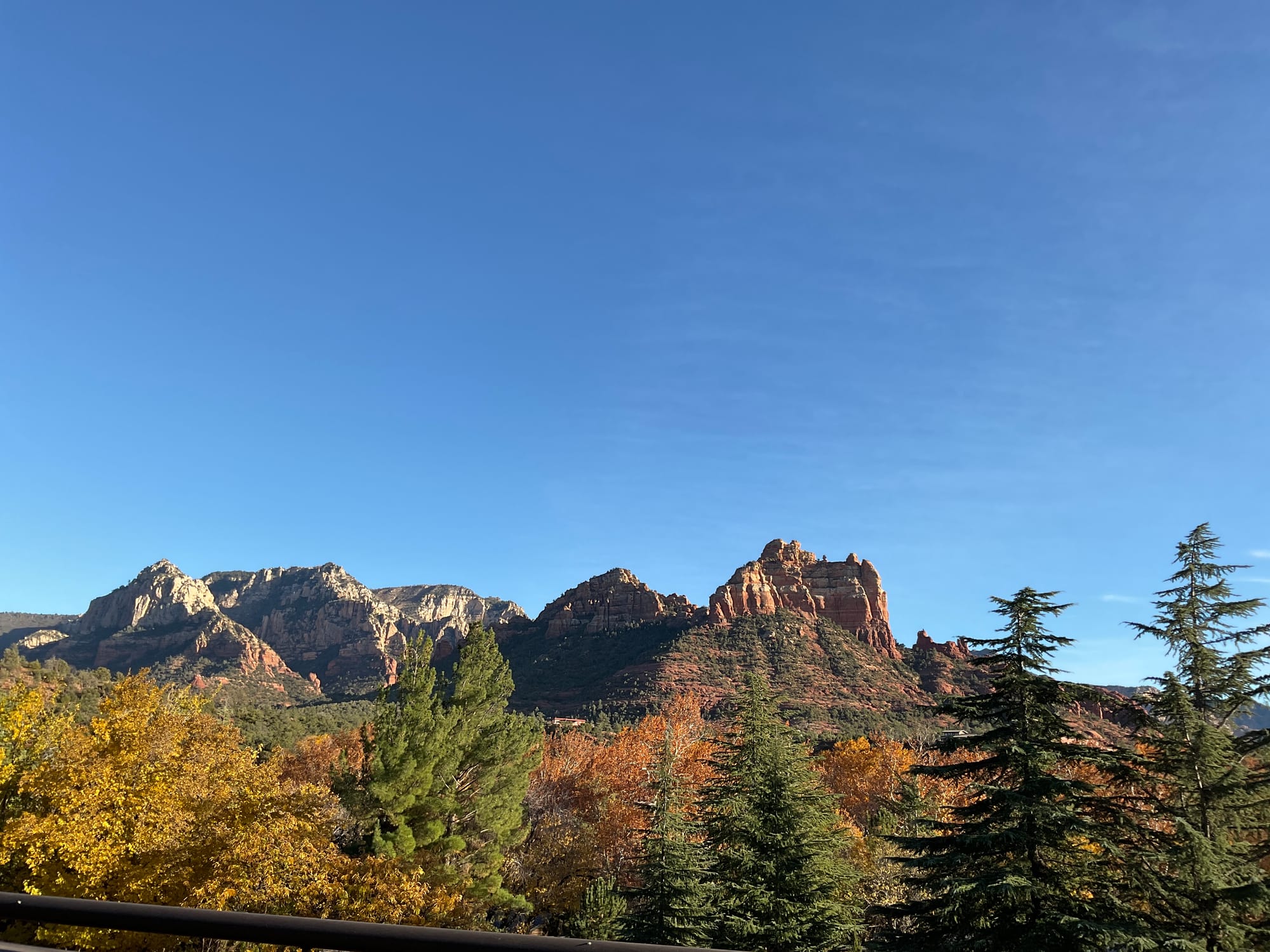
It isn’t that I don’t have anything to be thankful for on this Thanksgiving in America in 2024. I am seated before a stunning view, only partly captured in the photo accompanying this post. I have dear family and friends. Over the course of the past year, I left an institution I had thoroughly outgrown and moved to a wonderful new state. I could list more. But the problem with many of the things I’m thankful for is that they are too small. They are about me, my narrow life. On better Thanksgivings, I have had larger, broader things to be thankful for. I have been able to feel thankful to be part of a country actively working to realize constitutional democracy and a rule of law to underpin it. Thanksgivings where I could be thankful that more Americans had access to healthcare than ever before, where women had gained legal protection for their right to equal pay, where federal tax rates were adjusted in favor of lower personal income earners, where the Environmental Protection Agency was held to have an affirmative legal obligation to regulate greenhouse gas pollutants, where Americans as a whole seemed to be moving away from racism and homophobia, where U.S. military power was used to protect democracy and human rights in Europe. I could list more. Certainly on those Thanksgivings there were many aspects of American law, politics and culture for which I was not thankful. But overall my thankfulness easily ran beyond my own narrow well-being.
Jack Smith today moved to dismiss federal criminal cases against Donald Trump, cases meant to hold Trump accountable for his efforts to overturn the 2020 U.S. Presidential Elections and for his mishandling of classified documents. Smith is deferring, not to the scandalous Presidential immunity decision handed down by the Roberts Court last terms, but to U.S. Department of Justice (DOJ) policy against federal criminal prosecution of sitting Presidents. Smith wrote in today’s motion to dismiss the election overturning charges: “After careful consideration, the Department has determined that [Department of Justice] prior opinions concerning the Constitution’s prohibition on federal indictment and prosecution of a sitting President apply to this situation and that as a result this prosecution must be dismissed before the defendant is inaugurated.” Whether or not DOJ past opinions are legally sound or prudent, Smith’s decision to drop the federal criminal prosecutions is wholly unsurprising.
We have to read news and commentary quite selectively these days. In both, reliability is essential. But we also need to avoid overwhelming ourselves. Here are three items I recommend. (Publication links go to archived web pages. No paywalls.)
I spent today unwinding, catching up on life administration, meditating, knitting, and thinking. The thinking was meandering, creative, and constructive. Confronting the state of law, politics, and government in the U.S. is going to call for more days like this. It can be very hard to slow down and introspect in the face of the cataclysm the country now faces. It can feel like one must always be doing something on a larger scale, either specifically about the political and legal dangers or at least to distract oneself from them. Contemplation and a quiet pace can seem like they will only create room for fear, anxiety, disgust, and horror. Taking time for stillness and thought can seem unresponsive to the pressing need to help the country.
What I am sure of, though, is that inner strength and great imagination will be necessary to the fortitude and ingenuity that it will take to fix the country and help those most immediately suffering its brokenness. These projects will be ongoing for years, probably decades. There will be days and months when we will be agitating, campaigning, and otherwise operating at a rapid clip. But effectiveness at that pace depends upon underlying wells of deliberation and upon reserves of toughness.
I woke up today thinking about how fascists don’t always call themselves fascists. The Republican Party today is no different in this respect from the fascist National Socialist German Workers’ Party (Nationalsozialistische Deutsche Arbeiterpartei ) of 1920-45. In Italy, in contrast, the fascist party of the same period called itself, straightforwardly, The National Fascist Party (Partito Nazionale Fascista). Nomenclature was on my mind because I have been writing about Republican Fascism for a while now, using that term. And to the extent that my writing ever draws the attention of the Republican Fascists soon to be in control of the U.S. federal government or the attention of their supporters, they will object to my terminology. I already got a taste of this when I called the U.S. Supreme Court Court Justices in the Dobbs majority rogue and lawless. This flipped out Fox News commentator and George Washington law professor Jonathan Turley who wrote about it for The Hill. (I’m deliberately not linking. You can find his commentary easily). Manhattan Institute senior fellow Ilya Shapiro complained in the Wall Street Journal about my characterizing the Republican Party as a combination of a cult and criminal syndicate, and thus not a legitimate participant as a political party in U.S. constitutional democracy.
There are political and legal commentators who I read and learn from. Some, like Dahlia Lithwick of Slate and Anne Applebaum of the Atlantic, have written edifying, if absolutely alarming, pieces since November 5, 2024. But for the most part, commentary isn’t what we need now. We do need to keep track of planned and performed Republican Fascist maneuvers, at the federal level and in the states they control. We also need trusted expert information about the logistics of these. But then, what we most urgently need are people’s thoughts about how to confront these maneuvers.
I began my public online presence in 2007 with a small blog intended to keep interested friends about the volunteer travel I was doing for Hillary Clinton's primary run. That blog gained more notice than I ever could have anticipated, and I kept it going for a number of years. Eventually, the online world turned to social media. I stopped blogging and got active on what I will only refer to as the bird site. When that got bought by a fascist, I switched to Mastodon and the Fediverse, where I've been active ever since (you can find me there via @heidilifeldman@mastodon.social). Now, with the election of a fully fascist government at the federal level in the United States, I'm also going to blog again, here.
My first priority will be to gather some of the thoughts I've put on Mastodon since the 2024 U.S. elections. I will also selectively share links to others' writing that I think especially constructive or useful.
After that, I will use this blog to share my thinking about how to get through the Republican Fascist regime as it takes hold and how to resist and oppose it. I'm sure that the blog will have more than one incarnation but that's the plan for now.
In the aftermath of the 2024 U.S. elections, I’m trying to develop and strengthen habits and practices that help me maintain an even keel and to prepare for the Trump regime. Here is what worked for me over the weekend, in no particular order.
A long, somewhat challenging hike with my spouse, which included some good conversation and stretches of companionable silence.
Setting up this blog and starting to write it.
Proposing and starting to operationalize the idea of in-person gatherings of like-minded folks around the country. More about this at the thread on Mastodon that starts here.
Catching up with a friend via a long phone conversation.
Buying some yarn and knitting needles and signing up for a class to learn how to use them.
Refraining from trying to write a scholarly essay on a legal topic, even though I’ve promised the piece. I have to find a way to write about law-related topics that is constructive but realistic about the current state of American law. Legal scholars and lawyers must not do their work as if business is usual. More on my thoughts about this at the Mastodon threads that start here and here.
Alex Kelly and Jinghua Qian from the Economic Media centre share insights into the media landscape in Australia and the unique challenges this poses to movements working for economic and social justice, as well as practical tips and planning tools for engaging media.
This workshop was presented at FWD+Organise 2024, a conference hosted by Australian Progress in Naarm/Melbourne, Australia.
The State of Media in Australia: Challenges, Strategies, and Opportunities
Australia’s media landscape is undergoing significant changes, marked by a shrinking workforce and growing concentration of power.
Over the past 15 years, journalism jobs have halved, leaving fewer, less-specialised journalists covering more beats with less time. This, coupled with a lack of departmental fact-checking and editors, makes effective communication from spokespeople and organisations more crucial than ever.
Assigned Media’s street photographer shares some of her best photos from outside of the Supreme Court before and during oral arguments at U. S. vs Skrmetti on December 4, 2024.
by Piper Bly
Valorie Van-Dieman and Evan Urquhart of the Assigned Media team arrive at the Capitol.
While the trauma that Palestinians continue to face in Gaza is sustained, brutal and seemingly never-ending, the universal susceptibility to trauma unites humanity as much as it divides the self. Dr. Gabor Maté, renowned physician and expert in trauma and childhood development, illustrates this point articulately on the latest episode of The Chris Hedges Report through attempting to make sense of the psychology, trauma and reason behind the actions of Palestinians, IDF soldiers, WWII survivors, Nazis and even himself.
In the past few decades, the global pharmaceutical industry has seen a strong concentration of R&D and innovation centres in the Global North, and a progressive shift of generic drugs manufacturing towards low-cost developing regions. At the same time, there’s been the emergence of a few ‘excellence centres’, like Puerto Rico and Singapore, and the consolidation of giant hubs like India. Within this global scenario, South Africa was chosen to lead the WHO-sponsored mRNA Vaccine Technology Transfer Programme, a promising and innovative collaboration that may work as a pilot to boost pharma manufacturing in the Global South and facilitate access to vaccines. An example to follow, and to possibly extend?
In light of the commanding victory by Donald Trump and J.D. Vance in November’s election, conservatives are optimistic about the prospects for restoring American greatness. While I share this hope, it’s important to understand the true state of the regime and the character required to heal our nation’s wounds and unite the country around a shared political vision.
The American regime is ill, and everyone feels it. Yet few can agree on the diagnosis and fewer still on the cure. On the Right, some blame the alien germ of European progressivism that captured the imaginations of John Dewey and Woodrow Wilson, others Franklin Roosevelt’s New Deal, Lyndon Johnson’s Great Society, or the Supreme Court’s Engle v. Vitale decision banning school prayer—the list could go on. There’s some truth to all these narratives, but they elide more fundamental realities.
Cities’ capabilities don’t exist in isolation. To truly understand what enables cities to tackle complex challenges, we must consider the broader context in which they operate. Our recent research in Finland highlights the importance of these factors, revealing how cities leverage not just their internal strengths but also the support of national institutions, private foundations, and global initiatives.
Studying the Finish Country Context
Over the past six months, we conducted 28 in-depth interviews with officials from Finnish city, regional, and national governments, as well as urban experts from philanthropy, academia, and the private sector. While our full findings will be detailed in an upcoming report, here we share some key takeaways.
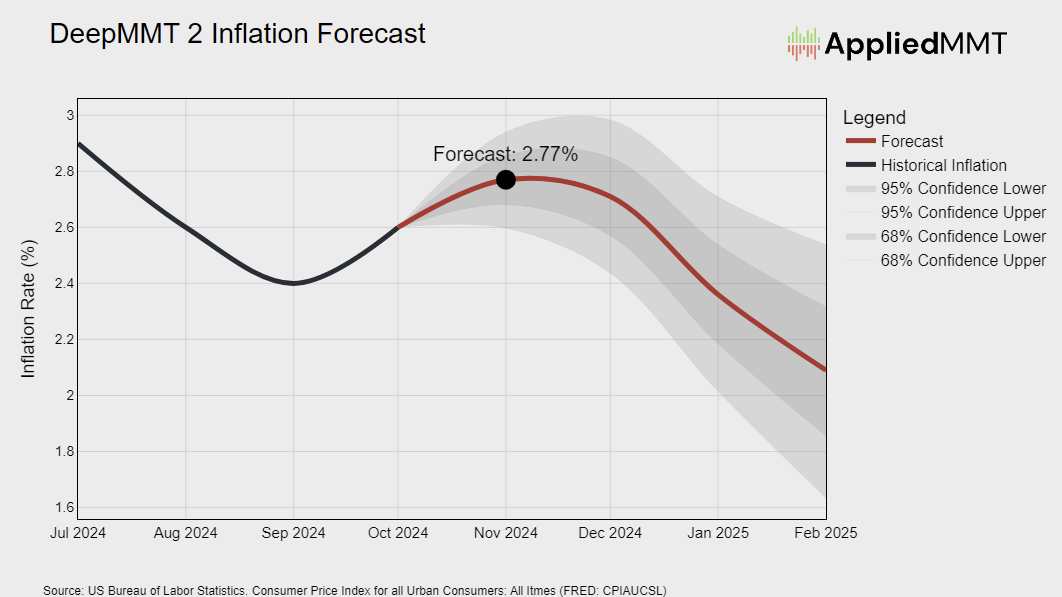
CPI for October came in at 2.6% today, inline with forecasts but persistent inflation remains a key narrative as we finish out the year. Today's 2.6% print aligns closely with projections from our DeepMMT 2 model (more to come on DeepMMT 2 soon) and we anticipate elevated CPI readings through November and December, with modest reductions expected to emerge in early 2025.
The Fed’s recent rate cut on November 7 has been incorporated into the model. After a two-day meeting, the Federal Open Market Committee noted that “economic activity has continued to expand at a solid pace.” The committee lowered the target rate range to 4.50% to 4.75%, as anticipated, with a unanimous decision.
Expectations of another 25-basis-point rate cut on December 18 have also been factored into our model. These projections, derived from the 30-Day Fed Funds futures, currently reflect a 63% probability of a target range of 4.24% to 4.50% for the upcoming decision.
It comes just one day after the approval of a 50 year extension to Australia’s largest fossil gas export plant – Woodside’s North West Shelf facility.
“These are fake numbers so the major parties can have a fake fight about fake climate policies,” said Rod Campbell, Research Director at The Australia Institute.
“The modelling released includes zero discussion of nuclear waste or the costs of decommissioning nuclear generation.
“Nuclear energy is not suitable for Australia’s energy market because it is expensive to build, can’t turn up or down quickly and the obvious nuclear waste problems.
“These issues are why no energy companies want to build nuclear in Australia, and key customers like aluminium smelters don’t want nuclear to be built for them.
“This is all a distraction to prolong fossil fuel use and exports.
“Just yesterday, a 50 year extension to Woodside’s enormous gas export facility was approved but it is barely covered because political leaders would rather talk about reactors that will never be built.
“Australia needs to get on with the job of cleaning up our industries using technologies that work – renewable energy.”
Gas companies made $56 billion in 2022-23 exporting liquified natural gas out of WA. They paid $0 in Petroleum Resource Rent Tax (PRRT). And most of the companies paid $0 in royalties.
How can WA be running short of gas? 90% of the gas produced in WA is either exported or used by the LNG industry itself to process gas.
The LNG export industry consumes:
32x more gas than WA’s electricity generators.
30x more gas than WA’s mining industry.
8x more gas than the rest of the WA economy and community combined.
Four things you need to know
1. Royalties – most of the gas industry in WA pays no royalties
The LNG industry is 83% foreign owned, so most profits go overseas. Royalties from the gas industry are not significant in WA. Unlike the mining industry, most of the gas industry in WA pays no royalties at all. WA drivers pay more in vehicle registration than the gas industry pays in royalties.
This is because most gas is extracted from Commonwealth waters and the Commonwealth Government chooses not to charge royalties. Australia Institute research shows that $111 billion worth of LNG was produced from royalty-free gas and exported out of WA over the last four years. This gas was effectively given to multinational companies for free.
Why are economists are so bad at predicting what’ll happen in the economy? Why is HECS indexed? And why do we measure labour as a cost but profit as a universal good? On the final episode of Dollars & Sense for the year, Greg and Elinor answer your questions about the economy.
This discussion was recorded on Thursday 12 December 2024 and things may have changed since recording.
In the aftermath of Donald Trump’s election victory, many education reformers are saying that now is the time to eliminate the U.S. Department of Education. Elon Musk and Vivek Ramaswamy, the presumptive leaders of the new Department of Government Efficiency, have been strongly hinting that eradicating the DofEd outright is a real possibility.
That’s an attractive goal—the DofEd wastes a great deal of money and does a great deal of damage to American students. But eliminating it outright will be difficult. Education reformers need 60 votes in the Senate to abolish the Department of Education. Using budget reconciliation might allow that requirement to be sidestepped, but it’s doubtful that Congress will go along with that tactic. Additionally, the Trump voting coalition isn’t just made up of small-government conservatives—it includes voters who don’t mind big government so long as it isn’t woke.
Also, “abolishing the Education Department” can mean less than meets the eye. Every single office and program can be transferred over to the Department of Health and Human Services—uncut, unreformed, and unchanged. Putative reformers could declare a hollow victory while supporters of the radical education establishment would then happily perform their outrage dance, secure in the knowledge that nothing really has changed.